A new cavalry unit in Thailand's north-east: Old wish, new threat?
Originally published at Siam Voices on March 2, 2011 The Thai military is getting a new cavalry unit near the north-eastern town of Khon Kaen. The cabinet has recently approved the formation of the 3rd Cavalry Unit (essentially a division of tanks) that will cost 70bn Baht ($2.3bn). This is also a treat for privy council president Prem Tinsulanonda, who has mentioned that a third cavalry unit is a long-held one last wish, since he himself hails from the cavalry. But why is this approved now:
The new division of tanks will be a supportive unit for the Second Army Region serving along the northeastern border with Cambodia and Laos. (...)
Tanks played a key role in the fresh clash between the two neighbours when heavy weapons, including tank artillery, were involved at the border area near the Preah Vihear Temple from February 4-7.
"Cabinet approves new Army divisions", The Nation, February 2, 2011
Of course, why not use the recent clashes at the border as good opportunity to request more troops, equipment, vehicles and thus more money - not that the army isn't getting enough new toys in recent months.
But before the recent clashes at the Thai-Cambodian border the reasons for the new cavalry unit were a bit different:
The idea of setting up a 3rd Cavalry Division arose from army restructuring. The changing national security situation and perceived threats were taken into consideration when deciding on the restructuring, the supreme commander said.
"Cavalry unit for Khon Kaen eases closer", Bangkok Post, January 7, 2011
"National security situation"? I wonder what that means? Let's go back to last summer:
Apart from the 7th Division, the army also plans to set up the 3rd Cavalry Division in Khon Kaen. (...) Although sources said that the set-up of the two divisions will be developed concurrently, the 7th Infantry Division looks set to progress faster than the 3rd Cavalry as it requires a shorter time and smaller budget. The 3rd Cavalry division will require a budget of about 70 billion baht to establish, plus a timeframe of about 10 years. (...)
Politically speaking, there is every reason to believe that the 7th Division will be set up sooner than the 3rd Cavalry, especially when considering the mission of battling Thaksin Shinawatra and the red shirts, a task for which the government has no one to rely on but the military. With the 7th Division in place, the government would certainly benefit.
"Red presence forces military to establish new division", Bangkok Post, July 29, 2010
Oh, of course! Since Khon Kaen is considered to be a red shirts stronghold it does only make sense for the government and the army to try to gain more control over the region. Now what would they do?
After the crowd dispersal at Ratchaprasong intersection in Bangkok, the army under the Isoc recorded the names and addresses as well as ID cards of the red shirts involved before releasing them. The army then visited them at home to try to provide "healing" in its own inimitable way.
"Red presence forces military to establish new division", Bangkok Post, July 29, 2010
Guess these people are in the same annoyance level of door-to-door salesman and missionaries. Kidding aside, the plans to speed up all these military projects show the original intent of the armed forces -control of its own people. And with a military chief determined to protect the nation's highest institutions from what he sees as their enemies, one can see why. On the other hand though the military is at the moment busy with fighting at the Cambodian border for very dubious reasons.
Saksith Saiyasombut is a Thai journalist and blogger still based in Hamburg, Germany. He can be followed on Twitter @Saksith.
Thailand journalist death: More criticism of DSI probe
Originally published at Siam Voices on March 2, 2011 The most recent findings of Thailand's Department of Special Investigation (DSI) that the death of Japanese cameraman Hiro Muramoto during the clashes in Bangkok last April was not caused by the military draws more criticism (see our most recent coverage here and here). Both the Committee to Protect Journalists (CPJ) and Reuters have voiced their concern about the findings and have pointed out the contradictions.
The DSI claims to have found "AK-47 bullet wound patterns" on Muramoto's body and since the Thai military is officially not using this rifle, they absolved the soldiers of any fault - despite contradicting a previous report that the Reuters cameraman was killed by a shot after "gunfire flashed from the direction of soldiers". Furthermore, there have been rumors that this comes after the army's chief of staff paid the DSI a visit to protest the previous finding.
Shortly after the announcement on Sunday, the Bangkok Post reported via a source how the DSI actually came to this conclusion:
The source said that while Pol Lt Gen Amporn might be providing advice to the DSI, he was not among the people who observed the autopsy to determine the cause of death of Muramoto. He was overseas at the time. Pol Lt Gen Amporn only analysed the cause of Muramoto's death from photos of the wounds on his body and concluded that the wounds were caused by an AK-47 rifle.
The panel itself had concluded that Muramoto was hit by two bullets fired from a high velocity gun, once in the head and the other in the heart, the source said. Given the pattern of his gun wounds, it was believed he was shot dead by a sniper, and normally snipers use an M16 rifle, not an AK, the source said.
The panel did not reach a conclusion about the exact type of weapons used in the killing of Muramoto and the other people because no bullets were found in any of the examined bodies, the source said.
"No firm view on AK-47 role in deaths", Bangkok Post, January 28, 2011
The latest to slam the DSI's finding is Metropolitan Police Bureau deputy chief Pol. Lt.-General Amnuay Nimmano. He said to the media that:
He said the DSI jumped to the conclusion the fatal shot must have been fired from the direction of a group of red shirts confronting the troops. For this information they relied on the dead man's camera, in which the last shots shown were of soldiers.
"It turns out that the camera's lens was covered, and the camera did not work the moment he was shot. A person can turn in any direction when [hit by a bullet]," said Amnuay. (...)
"It's DSI's own theory, own leads, own investigation and own conclusion, without police getting involved, and based on nothing convincing or credible. To put it simply, the conclusion is simply muddled," Amnuay said.
"Police refute DSI finding on shot cameraman", The Nation, March 3, 2011
My take: The moment I read about bullet patterns, I was (more than usually) skeptical. No bullets, just patterns!
As pointed out by in the comments on my previous article, even though the army does not use the AK-47 rifle it uses the same kind of 7.62 caliber bullets. These bullets are also used by the SR-25 and the SSG 3000 - both are sniper rifles used by the Thai armed forces. Military snipers were seen numerous times during the protests, especially during the crackdown in May 2010, and multiple witnesses claim to have seen armed men shooting from above during the April 10 clashes as well. So there is a possibility that Muramoto has been shot - deliberately or not - by military soldiers.
The DSI and their fact-finding are losing more credibility (not that they had much to begin with) with this apparent u-turn and with their inability to full shrug off rumors of colluding with the military, there's no other verdict than that this an active cover-up to evade full responsibility.
h/t to ricefieldradio for the aforementioned pointer
Thailand's DSI: Cameraman not killed by soldiers during 2010 protests
Originally published at Siam Voices on February 27, 2011 The Department of Special Investigation has revealed new evidence regarding the death of Japanese Reuters cameraman Hiro Muramoto, who was killed while covering the violent clashes on April 10 last year during the red shirts protests, that re-interprets the circumstances:
The army is breathing a sigh of relief after a Department of Special Investigation (DSI) report concluded troops were not responsible for the death of a Japanese cameraman during last year's red shirt protests.
However, the relief may be short-lived, amid claims that the army chief of staff paid the DSI head a visit to complain about an initial department finding which claimed the opposite - that soldiers should in fact be blamed for Japanese cameraman Hiroyuki Muramoto's death during the rally at Khok Wua intersection on April 10 last year.
The DSI is likely to face questions about why it changed its stance, though DSI director-general Tharit Pengdit yesterday stood by the latest report, saying it was based on scientific and forensic findings. He also denied meeting the army chief of staff.
The weapons report, which he did not release, found that the Reuters News Agency cameraman was shot dead with an AK-47 rifle while covering the clashes. In that case, troops could not be blamed for the death, said the report, because they carried different weapons.
Mr Tharit said Muramoto's body was found with AK-47 bullet wound patterns. Soldiers had not used the weapon, he said.
"DSI changes ruling on cameraman's death", Bangkok Post, February 27, 2011
This comes after an earlier DSI report, which has been leaked to Reuters, showing that...
Muramoto, a 43-year-old Japanese national based in Tokyo, was killed by a high-velocity bullet wound to the chest while covering protests in Bangkok's old quarter.
The report quoted a witness who said Muramoto collapsed as gunfire flashed from the direction of soldiers. Thailand's government has not yet publicly released the report into his death despite intense diplomatic pressure from Japan.
"Exclusive: Probe reveals Thai troops' role in civilian deaths", Reuters, December 10, 2010
The DSI explains this contradiction with the presence of armed, black-clad men, that reportedly roamed the streets during the clashes and were either allegedly red shirt security guards of rouge red shirt General Seh Daeng (who honestly was a loose canon - no one was really sure what he and his men were up to) or allegedly a 'third hand' to deliberately create chaos, depending on who's making these allegations. But, to adapt what Bangkok Pundit said at one time, it could have been the mysterious gunmen standing next to the soldiers, which they didn't notice anyhow. On the other hand though...
An army source (...) also said the army had imported about 20,000 AK-47 rifles into the country two decades ago. About 19,000 of them had been distributed for use at military camps nationwide, while the rest were kept at the army's weapon storage site.
"DSI changes ruling on cameraman's death", Bangkok Post, February 27, 2011
No doubt that the investigations into the circumstances of the many people killed during the protests last year is an impossibly difficult task. It can be expected that gathering evidence and witness accounts will be an uphill battle, especially when dealing with government authorities who are either unwilling to cooperate or directly intervene as indicated above. But also lot of pressure is coming from the red shirts demanding clarification and, more importantly, responsibility.
What is more important, though, is that the probes have to be thorough and impartial. With many cases still inconclusive (including the death of the other foreign journalist Fabio Polenghi), the DSI investigations so far do not help to ease the tensions in this still volatile political atmosphere, where one side is demanding the truth and the other side apparently fearing that the truth will create unrest. But this increases the dissatisfaction (and impatience) even more and leaves yet another wound in the Thai historical soul.
The tale of two trials: Da Torpedo and Chiranuch Premchaiporn
Originally published at Siam Voices on February 25, 2011 Over the last weeks both the international media and to some extent the local media as well have taken great interest in the trail of Chiranuch Premchaiporn, webmaster of the news site Prachatai, who has been charged for anti-monarchy comments on the website made by one of the readers, despite having complied with the authorities in removing them. See our previous coverage on the day when she was arrested (for the second time) back in September last year here and here.
Earlier this month the first part of the trial went ahead and lasted five days with the prosecution's testimonies marking the beginning. Guest contributor John Dent has observed the first day for Siam Voices and comments on the first testimony:
Day one of the trial started with the prosecution’s testimony of Mr. Aree Jivorarak, Thailand’s Ministry of Information and Communications Technology’s (MICT) IT Regulation Bureau chief. Among his other duties, Mr. Jivorarak is one of the key officials tasked with censoring Thailand’s Internet. (...)
For sake of argument, let us accept Mr. Jivorarak’s premise, that webmasters should (or even can) filter user comments. (...) While the specific guidelines are still being drafted, in practice it is up to the “authorized officer” at the MICT to decide retroactively what stays and what goes. Such decisions are often inconsistent and subject to the personal interpretation of Thai government officials.
So what is a webmaster to do? According to Mr. Jivorarak’s testimony, it would seem that they are expected to know what a censor may find inappropriate at a future date, before the content itself has been posted. Simply put, they are expected to peer into the hearts and minds of censors through space and time to decide what goes online. Not a minor achievement of precognition and quite a burdensome requirement for anyone operating a web site.
"Observations from the trial of Chiranuch Premchaiporn", John Dent, Siam Voices, February 6, 2011
In the following days, more witnesses for the prosecutionmade their testimonies. The website Freedom Against Censorship Thailand (FACT) have posted daily summaries from the hearings and here are some interesting tidbits:
[Day 2] A posting to Prachatai’s web forum included a hotlink to a Mediafile audio file of of a speech made from a Redshirt stage by Darunee Charnchoensilpakul, nicknamed Da Torpedo. Darunee was torpedoed with an 18-year sentence for this instance of lèse majesté in which she called for abolition of the Royals.
The audio file was not enough for our MICT. The file was transcribed and added to the police charges against Chiranuch. However, Mediafile was not blocked and no prosecution was initiated against the file’s uploader.
This raises a crucial legal question as yet untested. Does the Computer Crimes Act criminalise hotlinks?
[Day 3] The second witness for the prosecution, Thanit Prapathanan, a legal advisor to Thailand’s ICT ministry since 2005, (...) stated that any intermediary shares the same criminal liability as the poster. Creating a hub for people to communicate and share information made Prachatai liable for all its webboard’s users. (...)
Defence lawyers pointed out that the ICT ministry’s website itself linked to media hosting lèse majesté content. The witness stated that MICT could not delete content from third parties so was, therefore not liable for their content. This appears to contradict his statements of Prachatai’s liability for postings, comments and hyperlinks not their own.
[Day 5] Colonel Dr. Wiwat Sidhisoradej is a police scientist and has a doctoral degree in physics from Chulalongkorn University appearing for the prosecution. He copied Chiranuch’s laptop hard disk seized by the police on March 6, 2009 for forensic analysis. (...)
The most interesting part of the police scientist’s testimony was regarding the way email works. Thunderbird, an offline email client similiar to Microsoft’s Outlook application was found on Jiew’s laptop. (...) Dr. Wiwat readily conceded the probability that the images and postings were received by Chiranuch in email and were not redistributed by her. (...)
Col. Wiwat said that a computer user could not be in violation for simply receiving these emails.
After the last hearing on February 12 and with just five witnesses out 14 having given their testimonies, the trail will resume in September later this year, due to scheduling conflicts of the judges.
In a similar, but less prominent case, the aforementioned Daranee Charnchoengsilpakul alias "Da Torpedo" has won an appeal against the criminal court and her case has been declared a mistrial. She was imprisoned and convicted one and a half year ago for making anti-monarchy comments during a red shirt rally in 2008.
The reason for most recent turn of events was a petition filed by Daranee which argued that the absence of the public and cameras, as cited by the prosecutors on the basis of national security considering the contents that are being discussed, it would contravene with sections of the constitution that it should be an open trial. Since this petition has not been been forwarded by the criminal court to the constitutional court as requested and the prosecution went ahead and convicted her anyways, the appeal court pointed out this flaw and the trial has to start anew. Nevertheless and despite the conviction being annulled, Daranee has not been released and bail has been denied.
While both cases seem to be different, they both share the same problem with the draconian legal ramifications these two and many other people have been accused of. The fact that we cannot discuss what has actually been said and thus the extreme vagueness of the application of the law restricts an open discussion. This vagueness does not help to refute the impression that the lese majeste charges are being indiscriminately used to silence either inconvenient truths or political foes.
Thai cyber-police's warning to netizens abroad
Originally published at Siam Voices on February 22, 2011 2Bangkok.com has posted has a scan from a booklet provided by the Thai Ministry of Information and Communications Technology (MICT) explaining the following:
The page reads: "Michael: Does everyone know that the bill regulating computer crimes is subject to penalize the wrongdoer outside the Kingdom of Thailand as well? If there is anyone who starts a website outside the country to distribute information disgracing the monarchy, destroying the security of the juristic system or generating fear among Thai people, the wrongdoer will be persecuted by law and receive penalties inside the Kingdom of Thailand."
"MICT booklet explaining Thai internet laws: We can get you wherever you are on earth", 2Bangkok.com, February 22, 2011 (translation by 2Bangkok.com)
This snippet refers to a passage of the Computer Crimes Act of 2007, where...
Section 17 Any person committing an offence against this Act outside the Kingdom and;
(1) the offender is Thai and the government of the country where the offence has occurred or the injured party is required to be punished or;
(2) the offender is a non-citizen and the Thai government or Thai person who is an injured party or the injured party is required to be punished; shall be penalized within the Kingdom.
Computer Crimes Act 2007, unofficial translation by Prachatai.com
Essentially the MICT is now threatening to expand its crackdown on cyber-dissidents beyond the borders of the Kingdom after a move to clamp down domestically when several authorities joined hands last year with a strong emphasis on protecting the monarchy and controlling the political narrative against a perceived threat. This goes even so far that recently volunteer 'cyber scouts' are being recruited to monitor the web. Even though the blocking of by now over 113,000 websites has proven to be ineffective, the authorities are still keen to keep a very close eye on the flood of information and opinions.
via Thai Political Prisoners and New Mandala
"Black Khmer magic" a threat to the Thai army?!
Originally published at Siam Voices on February 20, 2011 During the most recent clashes at the Thai-Cambodian border the Thai military have beefed up their presence in the area with more troops, more military hardware and apparently also more amulets...?!
The chief of the 2nd Army distributed talismans to his troops to help protect them from evil curses which he believes Cambodians are likely to call upon in their fight over disputed border areas. As a result, soldiers guarding the border with Cambodia are now equipped with arms, life-saving kits - and talismans.
Second Army chief Thawatchai Samutsakhon issued assorted talismans to soldiers stationed at the disputed border area near the Preah Vihear temple in Si Sa Ket's Kantharalak district to ward off Khmer curses. "I believe in this and I have to take care of my subordinates in every possible way," Lt Gen Thawatchai said.
Lt Gen Thawatchai is a follower of the late Luang Poo Jiam Atissayo, a respected monk at Wat Intrasukaram in Surin's Sangkha district. (...)
An army source stationed at the border said he believed Cambodian troops would perform "some kind of rituals" on Preah Vihear temple to counter the army's distribution of talismans to its troops.
"Keep your talismans close, boys", Bangkok Post, February 12, 2011
Now, it would be easy to laugh it off as a quirky side note and call it a day. But you have to consider that superstition in ghosts and black magic is deeply rooted in South-East Asia and coexists alongside more established religions (and sometimes leads to some wild spiritual mashups). One big aspect of this are talismans and amulets that are supposed to give magic and/or protective powers from bad influences, but also bullets, knives and other worldly dangers.
So much so that in another incident, where two F-16 fight jets of the Thai Air Force have crashed during an exercise drill with US armed forces, there were persistent rumors that...
The air force spokesman brushed off a rumour that there could be a supernatural cause of the crash. "Do not believe in this sort of thing. I can't see how the crash could be related to that [black magic]. This is science: an engine problem perhaps, not superstition.
"Air force seeks clues to crash of F16 jets", Bangkok Post, February 15, 2011
Its impact reaches regularly into politics in Thailand, when there have been dozens of predictions by fortune tellers about the possible downfalls of prime ministers and/or military coups. And like all predictions, some are correct (partly), some are not (yet) and some utter nonsense!
For more on superstition and its influence on Thai politics I recommend you an article written by Pasuk Phongpaichit and Chris Baker called "The spirits, the stars, and Thai politics", available here.
BONUS: As said above, superstition is widely common in South-East Asia and doesn't stop at the highest ranking people. The Irrawaddy runs a story where Burma's military junta leader Than Shwe was seen wearing a women's skirt in "an intentional act of superstition" to nullify many fortune-tellers prediction "that a woman will rule Burma one day".
"Enter The RED Shirts" - An upcoming documentary
Originally published at Siam Voices on February 18, 2011 Several readers have pointed out a trailer for an upcoming documentary titled "Enter The RED Shirts: A Documentary Project" by Aphiwat Saengphatthaseema. The filmmaker himself explains his project as following:
I documented both camps’ activities on the field and found that the topic is very relevant to the interests of the Thai and foreign communities, who are interested, yet still confused about the politics on the road and the historical event of Thailand. (...) Despite the news coverage, the Thais and foreigners did not have a clear picture of the details of the incident. This documentary aimed to provided in-depth incidents under a theme “diving to the red shirt’s world.” It wanted to shed the light why we need to understand the red shirts.
The Thai society has ambiguous opinions about the red shirts, thus I want to portray why the red shirts think and decide to fight these ways. I use many viewpoints of people that inspired the red shirts on well-rounded basis and based my story on an “understanding” that the people should respect and tolerate the differences among them. (...)
I used black and white footage in the documentary to signify that we can look at them neutrally, naturally and instinctively as human being with some values on their own, regardless of being defined by colors during their struggles. Finally, their spirits cannot be defined or be delusive by the colors the distinct them apart. The black and white footage highlight “fundamental instincts” because the human complexities are indivisible and people cannot be simply categorized politically, unlike the spatial arrangement in the modern thoughts.
From the looks of the trailer, this is to my knowledge the first documentary film that attempts to create a complete portrayal of the recent political crisis and also a very detailed account of the red shirt movement, including what happened after the 2010 May crackdown. Many familiar faces appear in the trailer like Prachatai's Chiranuch Premchaiporn, social critic Sulak Sivaraksa, activist Sombat Boon-ngarmanong and many more. New footage might also give some new vantage points of key events.
All in all, this 8 minute preview is intriguing and we will certainly keep an eye out when the full movie is out. Be sure to check the trailer out below!
[vimeo http://vimeo.com/20006164 w=600&h=360]"Enter The RED Shirts : A Documentary Project." from Aphiwat Saengphatthaseema on Vimeo.
The Cambodian view on border clashes with Thailand
Originally published at Siam Voices on February 18, 2011 In a comment in the English language The Phnom Penh Post, co-founder and former editor-in-chief Michael Hayes expressed his view on the most recent Thai-Cambodian border clashes and reflects on the national feeling about this issue. He writes:
At the very least I’ve never been called a spin doctor for the Cambodian government. But on the issue of the current border dispute between Cambodia and Thailand surrounding Wat Preah Vihear, I’m as angry as all Cambodians are at what we perceive as a Thai-initiated conflict of grossly unjust proportions. (...)
The nagging question that perplexes us all is why Thailand is trying to export its domestic political problems and dump them on poor Cambodia? The sentiment here is that if the red shirts and the yellow shirts want to fight it out, do so somewhere in Thailand, but don’t use Cambodia as a scapegoat.
"The view from Cambodia", by Michael Hayes, The Phnom Penh Post, February 17, 2011
We have recently blogged about the Thai national(-istic) implications of the border clashes, but just to recap: The PAD are partly to be blamed for the recent flareups in battles at the border that begun earlier this year when seven Thais were captured on Cambodian territory including a Democrat MP and Veera Somkwamkid, an infamous activist of the PAD-allied Thai Patriots Network, who has been very vocal about the border issues and known to getting into trouble several times at the very same place. That's probably why Veera and another activist have been sentenced to multiple years in jail (btw, it looks like they won't get off the hook that easy via a royal pardon).
The PAD have been protesting since late January on the streets near government house and have repeatedly viciously attacked the government and also the army, who may have some "some wounded pride among the top generals as a result of the PAD's assertions that the army has been weak" (Source: Reuters). All in all, as hinted in Hayes' comment, the border clash is a result of Thai domestic politics and ratcheted up by the ultra-nationalistic PAD. But the red shirts are absolutely on the sidelines about this issue.
Hayes continues:
In the 20 years I’ve been in Cambodia the Preah Vihear issue is without question the only one I’ve seen that has united the entire nation. Cambodian TV stations have been running fundraisers off and on with donations large and small pouring in from all quarters for two years. Even the normally truculent Sam Rainsy Party and others in the opposition are fully on board.
"The view from Cambodia", by Michael Hayes, The Phnom Penh Post, February 17, 2011
Really? In an analysis by the Deutsche Presse Agentur (DPA) it paints a different picture of the Cambodian opposition:
Abhisit's PAD problems are somewhat mirrored in Cambodia by the opposition Sam Rainsy Party's hounding of Prime Minister Hun Sen. The party accused Hun Sen of neglecting land controversies in the border demarcation process with Vietnam while highlighting the confrontation with Thailand.
'He is trying to avoid the border issue with Vietnam,' said Chhaya Hang, executive director of the Khmer Institute of Democracy, a Phnom Penh-based non-governmental organization. (...)
Hun Sen might also be under pressure to speed up the Thai-Cambodian border conflict for budgetary reasons.
"ANALYSIS: Domestic politics muddy Thai-Cambodian border spat", DPA, February 9, 2011 (via KI-Media)
Nevertheless, Hayes' comment correctly points out the problems on the Thai side. The conflict stems from made-up false propaganda that is revived by the ultra-nationalists, partly to fight against their descend into obscurity, partly to avenge their disappointment over a government, which they thought have helped to come into existence.
This very government meanwhile, is trying stubbornly to keep this matter and its eventual resolution strictly bilateral, which is one of the reasons it has most recently refused to sign a ceasefire agreement with Cambodia, which asks observers from ASEAN to monitor to area.
Thai-Cambodian border clashes: Nationalist fever boils over
Originally published at Siam Voices on February 10, 2011 It has been nearly a week since the tense situation at the Thai-Cambodian border at the disputed ancient Hindu temple Preah Vihear escalated yet again, when troops on both sides exchanged gunfire and according to independent observers, killed 11 people on both sides. Even though no shooting has been reported since Tuesday, the current calm is more than fragile.
At the same time in Bangkok, the yellow-shirted PAD have been camping and rallying at Government House since late January, demanding the government to step down and calling for a stricter handling of the Thai-Cambodian border issue. By doing so, they are yet again playing the card of ultra-nationalism to justify their cause. But unlike at their last large-scale protest in 2008, this time it appears it is the only thing left for them is to cling on.
Ever since the rally started on January 25, the PAD's narrative and thus their constructed enemies were clear: Thai prime minister Abhsit, Cambodian prime minister Hun Sen, Thai defense minister Prawit Wongsuwan and the Cambodians at the border - they all have to leave in some way, whether its from their post or from the area the yellow shirts claim to be Thai soil. Additionally, the endless line of contributing speakers on the PAD stage are attacking the army for not being fierce enough with the issue, essentially calling them to reclaim the area by force.
But what is the PAD's rationale behind the ultra-nationalistic sabre rattling and the constant ripping of the current Thai government? Pavin Chachavalpongpun, a diplomat-turned-academic, explains:
At a deeper level, however, the conflict reveals a power struggle between the government and the PAD, the two main bastions of royalism in domestic Thai politics. The PAD is apparently manipulating the border dispute between Thailand and Cambodia to undermine the Democrat-led government of Prime Minister Abhisit Vejjajiva.
Relations between the two groups were not always so fractious. The Democrat Party and the PAD fought side-by-side to unseat the government of Prime Minister Thaksin Shinawatra and its subsequent proxies. They were both also willing to use anti-Cambodian nationalism as a rallying cry. (...)
But after it formed a government in late 2008 through a backroom deal brokered by the military, the Democrat Party gradually distanced itself from the PAD and its yellow-shirt protesters in an attempt to rebuild the government's image. PAD members were infuriated. Many believed that they helped install the Democrat Party in power but never got the credit they deserved from the Abhisit government.
"Thailand's Rising Nationalism", by Pavin Chachavalpongpun, Wall Street Journal, February 9, 2011 (full text can be read here)
Furthermore, political analyst Thitinan Pongsudhirak (also known to some as 'the Quotemeister'), sees in the PAD a larger danger to the government than the red shirts:
PAD leading voices have since turned their oratory guns broadly at the powers-that-be, including the current army chief, Deputy Prime Minister Suthep Thaugsuban, Defence Minister Prawit Wongsuwon, and especially Mr Abhisit. (...)
Mr Sondhi (...) has been playing up his overseas Chinese roots in defiance of what he calls the 'poo dee', the blue-blooded high and mighty with privileged backgrounds. This 'poo dee' happens to coincide neatly with the red shirts' battle cry in 2009-10 against the amataya, although no realignment of these two social movements appears in the offing. But if the various colours against the 'poo dee' and the amataya are lined up at a future point, the powers-that-be should be gravely concerned.
"Where is the PAD going this time with its protests?", by Thitinan Pongsudhirak, Bangkok Post, February 8, 2011
Shawn Crispin of Asia Times Online, elaborates on another angle:
Still, some have speculated that the military has swung back towards the PAD with the transition from outgoing army commander General Anupong to new chief Prayuth as a way to pressure Abhisit out of his early election plan. With the reappearance of the PAD on Bangkok's streets, this time as ultra-nationalists in defense of Thai territory, local newspapers have been awash in unexplained coup rumors. (...)
That leaves Abhisit to convince Prayuth that early polls are a better bet than backing the PAD and fomenting instability on the border.
"Bombshells and rally cries", by Shawn Crispin, Asia Times Online, February 8, 2011
The cracks between the PAD and the ruling Democrat Party were visible for some time already. The most recent scathing attacks by the yellow shirts are a more than crystal-clear sign that their bond is broken beyond repair. Apart from that, it reveals a jaded frustration among the PAD that not only in their view they were not being credited enough for bringing down three governments they saw as morally illegitimate to rule, only then to see the successor not being much better either.
The PAD's experiment at participating in politics (by 'normal' means) in form of the New Politics Party ultimately failed to break ground in the political landscape and at the local voting booths, thus leading many senior figures, including Sondhi, to leave the party and return to the streets with the PAD, as they see it as the only way to bully through their cause. Furthermore, the jaded frustration indicates their struggle against growing irrelevancy and obscurity, with the also anti-government red shirts reenergizing during their last few rallies (which were invited by one PAD activist to join them in chasing out the government).
Meanwhile, the sabre rattling by the PAD's rhetoric has reached a new low on Monday when the leader Sondhi Limthongkul has - well, read it yourself:
Yellow-shirt leader Sondhi Limthongkul has urged the Thai military to seize Cambodian territory, including Angkor Wat, to barter for Preah Vihear Temple. (...)
The Thai armed forces should move forward to seize Battambang, Siem Riap, Angkor Wat and Koh Kong. And then, in negotiations which would be arbitrated by China and ASEAN, Thailand would barter them for Preah Vihear and force Cambodia to adopt the watershed for border demarcation instead of the 1:200,000 map, according to Sondhi.
He said that a diplomatic approach should not be used in a military campaign. Thailand must take the most advantageous position before any negotiation, and it is not making war with China or Vietnam, but with Cambodia which has no warships. Thailand must wield its greater military power when it has to.
‘[To] whoever says that we’re mad for war, none of us sitting here want our children to [go to war and] die, but to die for a great cause, to protect the land, is worth it. We have 300,000 soldiers who are better equipped than Cambodian soldiers, but we lack the guts, because the senior military figures serve evil politicians. Today, [Defence Minister] Gen Pravit Wongsuwan is not a soldier, but a politician who says anything for political gain.’
"Sondhi urges Thai military to seize Angkor Wat in exchange for Preah Vihear", Prachatai, February 9, 2011
P.S.: Nationalistic fervor is not exclusively a Thai issue here. The Cambodian blog KI-Media has an analysis about the situation across the border.
Thailand’s Groundhog Day: Rumors of a military coup
Originally published at Siam Voices on February 2, 2011 Thailand faces an increased amount of rumors about a military coup again in the last few weeks with the latest being spewed out by Admiral Bannawit Kengrian:
The countdown to another military coup has begun, former deputy permanent secretary for defence Admiral Bannawit Kengrian said on Tuesday. [...] He said there were several reasons for the military to stage a coup.
There were many failures in the political sector. The people could no longer rely on politicians., independent agencies were weak, people banned from politics could still direct political activities and the Election Commission could not do anything about them.
Many groups of people of different political colours were out on the streets. Seeing no way out, the people would look to the military to break the impasse.
"Bannawit: Coup countdown has begun", Bangkok Post, February 1, 2011
So far, so predictable. The scenario Bannawit draws here has been going on for months now and with the red shirts regularly rallying and the yellow shirts now camping out for over a week now, things don't seem to change. But here is where his hypothesis beings to fall apart:
"The situation in this country is no different to that in Egypt. The people can no longer tolerate the political system and their protests are always fruitless. So they turn to the military," Adm Bannawit said. (...)
But from his experience in taking part in the 2006 coup, and several previous ones, and his personal acquaintance with nearly every politician and military officer, there were signs of a coup.
This time, it was the people that would join hands with the military to revolutionize the country and to stop the wicked cycle of politics. (...)
"Bannawit: Coup countdown has begun", Bangkok Post, February 1, 2011
It seems to be popular at the moment to draw parallels to the popular revolts in Tunisia and Egypt with Thailand. I hope to elaborate on this topic at a later point, but I can already say that this assertion doesn't really hold up. I'm especially certain that only a marginal size will side with the Thai army and I'm highly doubtful that the army is a constructive element to break free a political deadlock - at least he wasn't talking about democracy.
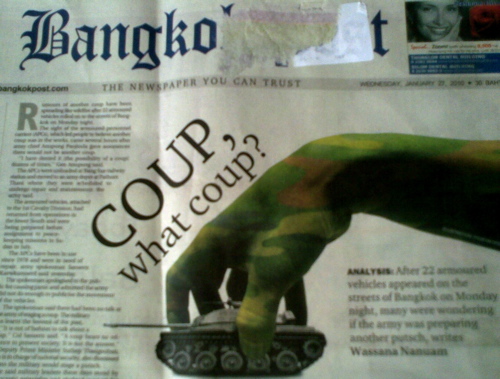
Also mentioned earlier, the rumors of a imminent coup are being thrown around in an almost inflationary amount in the last few weeks, almost a carbon copy of last year as pointed out by fellow Siam Voices writer Newley Purnell. It begun with red shirt co-leader and Puea Thai MP Jatuporn Prompan drawing his conclusions from a meeting of high-ranking military officers, then all sides (even his own party) denying his claims, followed up by a soothsayer (who are unfortunately still getting way too much attention, especially on political 'predictions') 'predicting' a 'drastic change' in April or May with a new prime minister, whose initial is allegedly 'P' or 'D', followed by an annoyed commander-in-chief Gen Prayuth Chan-ocha rejecting all rumors. And then there's Bannawit's recent prediction:
A countdown had begun to a coup, which could come in a few weeks, not a year or months.
"Bannawit: Coup countdown has begun", Bangkok Post, February 1, 2011
While it should be widely known by now that a coup is hardly the all-solving carte blanche, the mere fact that these rumors are flying around persistently indicates a sad reality that given the increased influence and the revitalized politicization of the military since 2006, another coup is never fully out of question.
Two Thais sentenced to prison for illegally crossing into Cambodia, what now?
Originally published at Siam Voices on February 2, 2011 The Nation writes in today's title story:
Veera Somkwamkid and Ratree Pipatanapaiboon were yesterday given lengthy prison sentences in Phnom Penh over charges of illegal entry and espionage in a case that could worsen ties between Thailand and Cambodia.
In the one-day trial, the Phnom Penh Municipal Court found Veera, who leads the Thai Patriots Network (TPN), and his assistant Ratree, guilty of espionage, illegal entry and trespassing in a military zone. These charges carry a maximum combined penalty of 11 years and six months.
Veera was sentenced to eight years behind bars and a fine of 1.8 million riel (about Bt18,000), while Ratree was given six years and fined 1.2 million riel (Bt12,000).
"Tough prison terms", The Nation, February 2, 2010
The two convicted were part of a group of seven Thais who got arrested by Cambodian authorities on December 29, 2010, claiming to investigate a disputed area at the Thai-Cambodian border. Among them was Democrat MP Panich Vikitsreth, who has received with four others suspended jail terms and have returned to Thailand already. See previous coverage here and here.
The Cambodian court have thrown the whole book at these two. The question is now if these two will have to serve the full term or will be eventually be granted a royal pardon (as seen in the 2009 case of a Thai national being accused of espionage), as two experts previously suggested on Voice of America:
“My opinion is that the first step must be through the court,” said Ros Chantraboth, a historian at the Royal Academy. “After the court's prosecution, based on a suggestion of friendship for both countries, [Prime Minister] Hun Sen will request from [King Norodom Sihamoni] their amnesty and release.”
Sok Touch, rector of Khemarak University, said first the judicial system must be allowed to work before diplomatic negotiations. “Cambodia should show its willingness to use the court system perfectly, and after that open political negotiation,” he said. “As we know, the monarch has the privilege of giving pardons.”
"Analysts See Royal Pardon for Arrested Thais", VOANews.com, January 12, 2011
Veera is a known activist and the leader of the nationalistic Thai Patriots Network, a group that is at least affiliated with the PAD, which are at the moment still camping out and protesting in Bangkok for a over a week now, dissatisfied with the Thai governments handling of the border issue. Speaking of which...
PAD spokesman Parnthep Puapongphan, speaking at the protest site outside Government House, said the government had never supplied any information that could help Veera and Ratree in court. (...)
Suthorn Rakrong, coordinator of the TPN (...) also said that leaders of the group would meet this morning to come up with a statement rejecting the Cambodian court's verdict.
"Tough prison terms", The Nation, February 2, 2010
This could be the reigniting spark for the prolonging yellow shirts' protests, now that they have one more reason to blame the government. It could be interesting to see what will happen today on the protests' stage.
British MPs voice concern over Thai webmaster trial
Originally published at Siam Voices on February 2, 2011 British MPs have signed a motion voicing their concern over the trials against embattled Prachatai webmaster Chiranuch Premchaiporn, who faces charges for violation of the Computer Crime Act and also lèse majesté. The Early Day Motion (EDM), proposed by Labour MP Tom Watson, warns that Chiranuch's case may threaten freedom of speech in Thailand and calls for the UK government to review it. The proposal was signed by 11 MPs from all three major parties. For more details on Chiranuch's case, see previous coverage here, here, here and here. Here's the notion in full:
That this House notes with concern the case of Chiranuch Premchaiporn, the Director of Thai news website Prachatai, who is on trial in Thailand under its Computer Crime Act for not removing third party comments criticising the monarchy from her website quickly enough and who, if convicted, faces a maximum sentence of 50 years in jail; believes that this action threatens Thailand's reputation for tolerance of free expression and risks creating a climate of fear; further notes with concern that this particular law has led to thousands of websites being blocked in Thailand; opposes web blocking and censorship; and calls on the government of Thailand to review the situation.
"Trial Of Chiranuch Premchaiporn", EDM number 198 in 2010-2011, proposed by Tom Watson on 10/06/2010
It has to be mentioned that the EDMs play generally a minor role with a low number of MPs signing them. Nevertheless this is, to this author's personal knowledge, the first public statement of Western politicians over this particular case and the general situation of freedom of speech in Thailand.
h/t to fellow Siam Voices writer Pokpong Lawansiri
Thai Navy plans to buy submarines from Germany
Originally published at Siam Voices on January 23, 2011 The Bangkok Post reports
The Royal Thai Navy wants to buy two second-hand submarines at a cost of 6-7 billion baht [$195m - $228m]. [...]
The specifications of the submarines have not been determined but the navy is expected to buy them from European suppliers, probably Germany.
The navy has stressed the need to acquire submarines because Thai sailors have little knowledge of submarine technology, which is constantly upgraded.
"Several neighbouring countries have submarines at their disposal. But Thai sailors have never come into contact with submarines. We are still backwards in terms of submarine technology," said the source. [...]
The plan has the backing of Prime Minister Abhisit Vejjajiva, who wants the armed forces to improve their capabilities in what is seen as a return of favours to the military for standing by the government in dealing with the red shirts during last year's protests.
"Navy wants to buy 2 subs", Bangkok Post, January 22, 2011
A local German paper, Kieler Nachrichten, reported recently that the Thai Navy wants to buy six used type 206 submarines from Germany. It continues:
Thailand's ministry of defense has promised their navy 500 million Euros [$681m] for the construction of a submarine flotilla in last March.
Bilateral talks between Berlin and Bangkok have already taken place. When the purchase contract with Thailand is ready to be signed is not known by this time. But the boats have already been inspected. The planned relocation of the submarines from Eckernförde to Wilhelmshaven for decommissioning has been stopped shortly thereafter.
"Chancen stehen gut: Großauftrag für HDW in Sicht", Kieler Nachrichten, January 18, 2011, translation by me
The story goes on that the Kiel dockyard company HDW is tipped to be contracted with the maintenance and preparation for the handover of the submarines, which is scheduled after March.
The Royal Thai Navy has long desired to buy new submarines for some time now (read here and here), including the suspected involvement of arms dealer Viktor Bout. The necessity though is debatable to say the least. Navy officials are repeatedly citing various reasons ranging from economic reasons (in the sense of securing trade routes by sea) to a "strong bargaining power in international negotiations" (source), which is clearly an offensive, if not aggressive, stance against its neighboring countries. While Thailand is so far the only one in the region that maintains an aircraft carrier, others like Vietnam, Malaysia, Singapore have or are in the process of acquiring submarines, leading to the suggestion of an arms race.
That said, according to Richard A. Bitzinger, Senior Fellow with the S. Rajaratnam School of International Studies (RSIS) in Singapore, even though it is not an arms race per se, it has its consequences:
If Southeast Asia is in the midst of an arms dynamic, as it would appear, it may still have a deleterious effect on regional security. Relatively considerable sums of monies are being spent on weaponry, perhaps with little regard to their actual usefulness in military situations (at least, the kind of likely military situations that would occur in the region), and the deployment of these weapons are no less potentially distressing to the regional security dynamic, especially if some event were to push the region into conflict. On the other hand, the acceptance that the region is in an arms dynamic and not an arms race means that the situation is not immutable and that the problem of arms proliferation in the region is resolvable, [...] easily comprehended, bounded and constrained. The cycle can be broken or mitigated, and it is certainly within the power of the local states to do so, should they choose to do so.
Bitzinger, Richard A.: "A New Arms Race? Explaining Recent Southeast Asian Military Acquisitions", in: Contemporary Southeast Asia: A Journal of International and Strategic Affairs, Volume 32, Number 1, April 2010
From a domestic angle, this is another one in a long list of the proposed equipment procurement of the army (see previous story on Ukrainian APCs and German engines to Thailand). In the greater scheme of things, this is also the result of the Thai government granting the army a bigger budget in order to secure their support. A Bangkok Post story from March 2010 (in anticipation of the red shirts protests) suggested that the armed forces were to file in their wish lists. Since the protests have been dispersed by the army, the government is now owing the rewards to them - no matter how useless, impractical or dubious these soon-to-be mothballed big toys will be.
Red Shirt to 'sue' Thai privy councilors over cable
Originally published at Siam Voices on January 12, 2011 Last week, VoiceTV* reported this:
Gen Prem Tinsulanonda, Anand Panyarachun and ACM Siddhi Savetsila were Thursday sued on lese majeste charges.
Gen Prem, the chief privy counsel and former prime minister, Mr Anand, a former prime minister, and ACM Siddhi, a former foreign minister, were altogether charged by Red Shirt movement for alleged lese majeste acts which might have possibly offended the Royal Household.
Red Shirt spokesman Worawut Wichaidit, who brought up the charges to Prime Minister Abhisit Vejjajiva at Government House, quoted cable messages circulated by WikiLeaks as saying the highly-placed trio had discussed varied topics with former United States ambassador to Thailand Eric G John a few years earlier.
"Prem, Anand, Siddhi Sued On Lese Majeste Charges", VoiceTV, January 6, 2011
The WikiLeaks cable, in which General Prem Tinsulanonda, the head of the privy council, Air Chief Marshall Siddhi Savetsila, also a member of the privy council, and former prime minister Anand Panyarachun were mentioned and their problematic implications were subject of a previous Siam Voices post by my fellow writer Andrew Spooner.
It has to be said first and foremost that the VoiceTV story is misleading and just simply wrong on so many levels (the main reason why I initially didn't write about this when it first came up). It gives the assumption that the three men have already been charged for lese majeste (let alone by the red shirts themselves), which is obviously not the case.
Normally, a lese majeste complaint would be filed at the police, which then would be checked by them and then decided whether to charge the suspect or not - as seen in the prominent cases of actor Pongpat Wachirabanjong (who was not charged) and Prachatai webmaster Chiranuch Premchiaporn (who was charged, twice!).
So what really happened? According to a short news item on Matichon, the red shirt representative has submitted a letter to Prime Minister Abhisit (hence why he showed up at Government House) notifying that the three men have committed lese majeste ("ยื่นหนังสือถึงนายอภิสิทธิ์ เวชชาชีวะ นายกรัฐมนตรี ให้ดำเนินคดีกับบุคคลที่เข้าข่ายกระทำความผิดต่อองค์รัชทายาท ประกอบด้วย พล.อ.เปรม ติณสูลานนท์ ประธานองคมนตรี พล.อ.อ.สิทธิ เศวตศิลา องคมนตรี และนายอานันท์ ปันยารชุน อดีตนายกรัฐมนตรี") because of the comments they made in the WikiLeaks cable.
That, of course, is a completely different story to the original VoiceTV story (btw, their video report in Thai is closer to the more accurate description) and also less dramatic. The chances are very low that this complaint will get anywhere, since any public discussion on these certain cables are virtually non-existent and the media coverage has been largely mum. But most possibly this was their intent to get more public attention and push the existence of these cables (and their contents) into the spotlight.
On Tuesday, The Nation's Pravit wrote an open letter voicing his displeasure on this matter. Key excerpts:
You must all be well aware that the lese majeste law is draconian and undemocratic. I know Prem is one of your arch-enemies, but first ask yourselves how crushing your enemies by using an undemocratic law would bring about a more democratic society? How then will you differ from the yellow-shirts who prefer a "good coup d' etat" as a panacea for all perceived political ills? (...)
There is no place for lese majeste law in a truly democratic society because citizens in a democracy should be able to express their "critical" views without fear of persecution. Your decision to use the lese majeste law to crush your enemies only makes Thailand more undemocratic.
I always feel that the reds are a bunch of people who cannot publicly and fearlessly express their political views regarding the ruling elite. So there is absolutely no need for them to instil more of this fear in others. It's tragic and ironic that the red shirts, long accused by their opponents of being anti-royalists are now resorting to using this archaic law against its opponents. (...)
Yours Truly,
A journalist who's often accused of being red and in bed with Thaksin.
"An open letter to the red shirts", by Pravit Rojanaphruk, The Nation, January 12, 2011
While it is debatable if the action of one (allegedly a spokesperson, nonetheless) can speak for the whole red shirt movement - which in itself appears to search for a common ground at the moment. But I agree with Pravit - it is a bad idea that can do more harm than good. The majority of red shirt movement want change in Thai politics and society, and I can imagine many of them want exactly the opposite of what one of them has done with his act.
*Honi soit qui mal y pense, just because this station is run by Thaksin's kids!
Dawei and Thailand’s stake in Burma’s industrial mega-project
Originally published at Siam Voices on January 6, 2011 Burma has vanished from the international headlines ever since the hotly debated elections and the release of democracy icon Aung San Suu Kyi from house arrest late last year. Around the same time there was coverage about the Thai involvement in the Burmese industrial complex Dawei, located on the west coast. Thailand is one of the few countries that has economic ties with the military dictatorship.
For Thailand it is an great economic opportunity and many big companies have invested - or are thinking about investing - in the project, as the New York Times and Bangkok Post explain:
The project is also crucial for geo-strategic reasons: Construction of a deep-sea port would create a shortcut between Europe and Indochina. Companies in Thailand and the fast-growing economies of Vietnam and Cambodia could save fuel and time by bypassing the long journey through the Strait of Malacca, a detour of several thousand kilometers. (...)
Italian-Thai has been awarded a huge chunk of territory for the project — 250 square kilometers, or about 97 square miles, more than four times the size of Manhattan. (...) Italian-Thai ... has been given exemptions from import duties and a 75-year concession to build and operate the heavy-industrial part of the project, as well as a 40-year concession for light industry, like garment factories.
"An Industrial Project That Could Change Myanmar", New York Times, November 26, 2010
The Burmese government is promoting the development of a huge port and industrial estate development in Dawei (Tavoy), for which SET-listed Italian Thai Development Plc will be a major contractor. The first-phase contract that ITD has signed for the 10-year project is worth an estimated US$8 billion. The entire project could be worth $58 billion or more.
Companies planning to invest in a Dawei industrial estate include PTT Plc, Siam Cement Group and the upstream complex of a Japanese steel company.
"Big shift to Dawei predicted", Bangkok Post, November 14, 2010
It is quite obvious why Thai companies look beyond the kingdom's borders to do their business if one recalls the troubles it has domestically, with one name being synonymous for corporate pollution in Thailand: Map Ta Phut.
For foreign companies, the project also means less environmental oversight. In the case of Thailand, new laws that require more environmental safeguards have slowed the expansion of the industrial complex at Map Ta Phut, the country’s largest petrochemical facility. (...)
By contrast, Italian-Thai officials said that there were no laws in Myanmar covering environmental protection but that they had conducted their own assessment of the likely impact in Dawei. (...) Somchet Thinaphong, who helped devise the master plan for Map Ta Phut, is the managing director of Dawei Development, which is to oversee the project. “This will be exactly 10 times bigger than Map Ta Phut,” Mr. Somchet said.
"An Industrial Project That Could Change Myanmar", New York Times, November 26, 2010
There's no doubt that the Dawei project will completely change the place beyond recognition, the NYT story goes on to say that at least 3,800 local households would be forced to move - the region is estimated to have 19 villages with around 5,000 residents.
On a bilateral level, it can be observed that the Thai government has more or less 'cuddled up' to the Burmese junta in recent times, as hinted during his last visit in October.
The construction deal was signed five days before Burma’s election last month, and it’s noteworthy that Thai politicians have becoming friendlier towards the Burmese ruling junta in recent years. When in opposition, Abhisit’s party was hostile to the military rulers next door – and critical of the then Thai prime minister, Thaksin Shinawatra, for cosying up to them. Such antipathy has now been forgotten.
"Why Thailand invests in Burma", by Simon Roughneen, Financial Times, December 2, 2010
One has also to recall how much Thailand already relies on Burma in terms of energy:
Thailand already relies heavily on Myanmar for energy; the Dawei project is only a few dozen kilometers south of a pipeline to Thailand built more than a decade ago by the U.S. oil company Chevron and the French oil company Total, and which supplies electricity for greater Bangkok. The sale of gas to Thailand, worth $4 billion last year alone, has been crucial in helping buttress the power of the military leadership in Myanmar.
"An Industrial Project That Could Change Myanmar", New York Times, November 26, 2010
This gold rush on Dawei goes to show that the Western sanctions on the military regime are not really working (as Abhisit himself pointed that out in an interview) and that the Thai companies are promising themselves the industrial el dorado that Map Ta Phut should have been. Maybe an economic boom is a chance for Burma to open up the country, but on the other hand the junta will keep a close eye on the progress and, given its track records, will be tempted to intervene, which ultimately is a high risk for the companies involved.
Videos show Thai MP, activists before arrest in Cambodia
Originally published at Siam Voices on January 3, 2011 Last week, seven Thais were arrested by Cambodian authorities for allegedly crossing the border into Cambodian territory illegally (check out previous coverage by fellow Siam Voices writer Thorn Pitidol and at Bangkok Pundit). Among the detained are Democrat MP Panich Vikitsreth and PAD-affiliated activists Samdin Lertbutr and Veera Somkwamkit. The latter is the leader of the Thai Patriot Network (TPN), known for its activities concerning the border issue, so much so it even got him into conflict with the PAD leaders themselves.
More details emerge about the circumstances of the arrest with the most important question being whether the men where (aware to be) on Cambodian territory or not. Three videos have appeared on YouTube (with no knowledge how the videos have been leaked, since the Cambodians must have seized everything) showing the men walking through the border region. In two of the videos, Panich is seen talking on the phone to someone.
[youtube=http://www.youtube.com/watch?v=5YTbiVA16Ss&w=600&h=360]"พนิช บุกรุกเขมรอภิสิทธิ์รู้ดี", video by 2011galet
Translated transcript of Panich's phone call (starting at 1:10 min):
"Hello [name], are you there? Can you hear me clearly? In case we lose the signal here, call Somkiat, the PM's secretary - because we'll/I'll will talk to him personally, anyways - tell Somkiat we've crossed the border into Cambodia, so we can coordinate it, in case something happens. Tell him - we're now on Cambodian territory! But don't let anyone else know about it, only the PM knows!"
The PM should know about this since, he ordered him to investigate the region.
The second video shows a local talking to the men and again we see Panich talking on the phone. Whether it is the same person or even the same phone call as in the video above is not possible to determine.
[youtube=http://www.youtube.com/watch?v=l2K9RwUE-zA&w=600&h=360]"พนิช วิกิตวิเศรษฐ์คุยกับชาวเขมร", video by 2011galet
Translated transcript of Panich's phone call (starting at 0:38 min):
"...tell him we've crossed. We'll try to get to point 46 [46th boundary monument], which is on the Thai side, but is inhabited by Cambodians."
A third video shows the men wandering around and discussing about the territory, before being apprehended by Cambodians.
[youtube=http://www.youtube.com/watch?v=lAKcdU-RKNY&w=600&h=360]"คลิป พนิช เข้ากัมพูชา", video by gigcode
Translated transcript
Veera (the man holding a video camera, pointing at the concrete pole): "This fence here is Thai ground."
Unseen staff member: "If we cross here, then we're in Cambodia?"
Veera: "This is Thai territory, but they [the Cambodians] have claimed this for themselves. They have claimed it based on the 1:200.000 map. Thais can walk up to this point, if they cross it here, it's [still] Thai, that's an old Thai village over there, but the Cambodians have seized it all."
Panich: "Now it's full of Cambodians?"
Veera: "Yes, full of Cambodians! Let's go, if we go there, we'll get arrested for sure!" (group walks off)
Unseen staff member: "The border police will come...they will follow us."
Panich: "Our soldiers don't dare to come here?"
Veera: "If we get caught, the border police will come and help us out."
All: "Ah, here they come! They come in many. The soldiers are coming..."
Panich: "Are these their [Cambodian] troops?"
Veera: "Police Lieutenant Colonel Sawat, the one who helped me once, he insists that this Thai territory. [...] So, if we get caught, he'll help us" [...]
[Scene with Panich phone calls, the same as in the clips above]
[Scene at 2:15 shows them walking and Veera noting that they are now in Ban Nong Jarn (บ้านหนองจาน) and that they'll probably be arrested soon]
[Scene beginning 2:45 shows the group being stopped by a Cambodian man, possibly a soldier?]
[3:11, another man on a motorcycle arriving]
Cambodian man 1 (in Thai): One month ago there was no problem.
Thai group member: But this month there is a problem?
Cambodian man 1: You haven't told that you'd come...
Thai group member: Told whom?
Cambodian man 2: The police, the Thai border police...!
[The rest is entirely in Cambodian, some bits the author understood included along the lines of "We can talk about it" etc.]
Now, it is difficult to draw conclusions from these clips without the context. The clips do not show where exactly the group has been arrested. Furthermore, we haven't seen much of the locals - the one lady doesn't give much away. And how were the clips leaked? Nevertheless, some questions arise though: Was Prime Minister Abhisit aware of the group going entering Cambodian soil? Where was the Thai border police this time, if Veera claims to be certain that they would help? Was a deliberate attempt by the group to be arrested, since Veera was certain on that point as well? And ultimately, was the group on Cambodian territory or not when they were arrested?
In related news, there has been much action because of this in Bangkok as well. First off there was the admission (we can't talk about a confirmation per se) by Deputy Prime Minister Suthep that the group was on Cambodian soil. Then there was the rest of the TPN unsurprisingly up in arms about the arrest, so much so that they want the UN to help. And in the most recent developments, the TPN announces to protest at the border. As expected, the Thai authorities have declared the area a no-go zone. The TPN has led a similar protest in September 2009 at the border in Srisaket province, which in ended in clashes with police and locals. Also, in the latest absurd turn of events, TPN core-leader Chaiwat Sinsuwong blames defense minister Prawit Wongsuwon to have tipped off Cambodian troops to have the seven men arrested. The cynic in me says that the PAD must be delighted with the arrest of the seven men, since they would otherwise have nothing to protest on January 25 (except for some charter amendments maybe).
General Prayuth's Wish List for 2011
Originally published at Siam Voices on December 29, 2010 It seems that Thailand's army commander-in-chief General Prayuth Chan-ocha is already being more outspoken in public (with a public outburst being his last outing) than his predecessor(s) in such a short time, considering he just took up the post in October.
This week, he outlined four points on his wish list for the new year. Let's go one by one, shall we?
"For the people and army personnel to enjoy the New Year" Well, duh! Nothing much to explain here.
"For the monarchy not to be offended" He's got that point covered as well after the announced his crackdown on all anti-monarchists and he has put this on the top of his priority list during his tenure.
"For peace to return quickly to the southern border provinces" If there's any superficial sign of improvement or at least what the authorities want to signal to us, then the apparent upcoming end of the state of emergency in one district in Pattani might be one - even though it will be replaced by the Internal Security Act (ISA). The same happened in Bangkok last week.
"For sustainable peace on the borders with neighbouring countries." Of course this is a reference to the ongoing dispute over Preah Vihear temple at the Thai-Cambodian border. Prayuth added that "unsettled border disputes should not be raised unnecessarily because doing so would only make people become emotional." Well, let's see if he'll stick to his words when the PAD will protest about this very issue on January 25, 2011 or if he'll let them pass.
But wait, there's more!
Asked about the army's stand on politics, Gen Prayuth said the army must not side with any parties in conflict but must maintain and adhere to the law, regardless of who is the government, to prevent casualties to the people.
The army chief said the people should no longer talk about which colour they belong to, because this would only prolong the conflict between them.
He promised not to lead the army in another coup, because it is against the law. "Nobody wants a coup and the chance of there not being another coup is 100 per cent," Gen Prayuth said.
"Gen Prayuth's New Year wishes", Bangkok Post, December 28, 2010
Firstly, if a flawed opinion poll from earlier this year is anything to go by, then the army shouldn't be influenced by politics at all anyways. Secondly, if Prayuth advises people to go color-blind, then he himself should stick to his own words as well, since he was allegedly promoting and demoting army officers for political reasons.
And finally, about the pledge not to stage coup - well, we'll have to see about that...
2010 - Some Personal Thoughts
I'm not good at writing a sentimental intro for a yearly review, especially if it has to be somehow holiday-themed. But many things have happened this year that are still stuck in my mind after all these months it is only appropriate to look back at it now. Without further ado, here a some thoughts of the year gone by: Of course the biggest event of 2010 were the anti-government red shirt protests earlier this year that went on longer than anyone has expected. Somehow I'm still amazed that over these nine weeks there was still a new angle worth writing about and still uncovered aspects of the protests, let alone the countless dramatic developments. I will now not recap each and every single thing that has happened (that's what the archive is for!), but looking in hindsight I sadly have to acknowledge that not much has happened that might improve the situation. Therefore, my rant back in May just right after the end still stands to this day - there is a lot to be done!
There were several stories this year that were incomprehensible or just mind-boggling for me. For example, there was the government's ludicrous response to Aung San Suu Kyi's remarks, only to be topped by an even more ridiculous suggestion of a senator that Myanmar's democracy icon might have been bought. Then there was Kasit's submissions for the 'foot in mouth'-award with not one, but two interviews to the foreign press where he displayed his 'knowledge' about European history. Other strange stories included an army spokesperson that became an overnight celebrity, a culinary culture war, the opposition in disarray and the antics of an Aussie in Bangkok - what was he thinking...?
Unfortunately, there were also other occurrences that made me genuinely angry and made me questioning the sanity of mankind (and I'm not talking about the website "People of Walmart"). In no particular order: the army's insistence to continue using the GT200 device, which is already proven to be bogus (and having no shame to openly show their incompetence in presenting it); Krispy Kreme mania and people still going gaga over it (seriously, are people that brand-fixated to call even what is originally blue collar baked goods in the US as high class?!), Thailand's inability to introduce the Kingdom to 3G technology (while almost every other country in the region having it already and about to move on to 4G); people calling other people 'uneducated' yet at the same time failing at grammar (and still having the nerves to claim intellectual superiority) and a 'managing editor' of a 'newspaper', who is more busy preaching the most insane tweets - ever saw a Buddhist extremist? I have this year...!

But enough with the ramblings. Since this my personal review, I'd like to look back to what I have actually achieved this year. Let me first go on record saying that when I started this blog back in February I had not the slightest idea where this would lead me to. I had no idea how the protests would play out. I think this was the trial by fire for me. Now, many will argue that with me being thousands of miles away from Bangkok, I wouldn't be able to accurately report on the situation. I'd like to disagree - I didn't try to give an up to the minute report on what was happening there right now (apart from the live-blogs when the situation seriously deteriorated day by day), I was rather trying to recap the events gone by during the day and since I wasn't on the frontline, I focussed more on giving a different overview and provide context to the reader, who are interested to know more about the backstory of what is ultimately a pivotal event in recent Thai history.
No doubt the biggest scoop for me was the story about Thaksin's visit at Nelson Mandela and the question if he was really there (spoiler alert: YES!). I'm still amazed by how it quickly I actually got an answer from the Mandela foundation the next morning, thinking they might have been bombarded with press inquires already overnight. What I've done was essentially the reporter's equivalent of going through the front door to the reception desk and kindly ask for information - basically that's journalism 101! But I was still first to ask, while the entire Thai media apparently was dancing around the issue and instead going straight to the source! The reward was over 3,000 clicks within three days after this story went online, countless retweets, some coverage on Thai media (ironically with no one actually contacting me), a column about me by Suranand Veijajiva and me imagining some long faces in a building at Bang-Na!
The other story that included a surprising twist was the protest of the red shirts in Hamburg last September, not only because it was a chance to incorporate some of my own photography into my article. Essentially the red shirts in Germany, as with the Germany-based Thai diaspora in general, are a particularly very homogenous bunch of old ladies. When the goal of this protest was to make the German passer-by aware of the political situation und injustice, then they have failed in my opinion, because nearly most of the time the speeches on the loudspeakers were in Thai and even the German contributions or the direct approaches left everybody unconvinced and ultimately uninterested. And atypical for a Thai-style protest there was no food and music! I was ready to call it a day until there was a call-in by Thaksin. So I took out my voice recorder and pressed 'record'. What he said wasn't particular earth-moving, but the fact that he called-in here in Hamburg and nowhere else at the numerous other protests around the world is kinda telling for me. What then happened was typical Thai though: after Thaksin rambled continuously for almost 11 minutes, he was suddenly cut off because the power generator ran out of fuel...
All in all, in hindsight, I still can't somehow realize what advancements I have made professionally. From an avid Twitter user and editorial assistant in 2009, starting a blog in February 2010 and then seeing the progress from that point on still leaves me in sheer amazement. I have never imagined to be a guest writer at Bangkok Pundit over the summer and this gig to be continued what is now Siam Voices - I have never imagined to be actually paid for what I do, even if it's not too much, and to make my passion eventually to a job! Also, I successfully hosted a panel discussion on the Thai political crisis at my university, the first one organized at a German university on this topic after the protests. I feel nothing but pride and gratitude for what I've achieved in 2010!
And finally - this has to be said: THANK YOU ALL! THANK YOU to all readers, followers, friends, colleagues and groupies (one can dream, ey?) for your support, feedback, criticism, retweets and links. Your appreciation and acknowledgment is what drives me to keep on writing - even if it's at times exhaustive and mentally draining. I wouldn't have been able to achieve all this without you and I hope you will continue to support me when I'm building my professional future. I hope to eventually finish with university and make the jump to Bangkok full time in order to start a journalistic career there! THANK YOU, THANK YOU, THANK YOU!
And now, I have a little Christmas present for you - straight from my personal video vault! Back in 2008, I worked for a short-lived revival of a student-run TV programme called UniTV.Hamburg, which is essentially like campus TV. It was the first time I got my hands-on working in TV production and since we were under-staffed (and unfortunately not by the most helpful ones), I got my hands on nearly everything: filming, editing, narrating, hosting, producing etc. I eventually hosted two shows with nearly all segments (both in-studio and recorded) done by me until I had enough of being an almost one-man-production. This segment was done in late 2008 and aired in January 2009 and portrays the extremely fun sport of Speed Badminton (with the help of the talented Christian Betzer and Juliane Bergmann). So, enjoy this video with me essentially jumping around like a fool for five minutes - you don't need subtitles for this!
[youtube=http://http://www.youtube.com/watch?v=qbHpmQ_h88U&w=600&h=360]"Speed Badminton - UniTV.Hamburg - Januar 2009", video by me
I wish all readers and friends a Merry Christmas, Happy Holidays and all the best for an awesome, successful and Happy New Year 2011!
How Much Did The CRES Cost? Don't Ask General Prayuth About It!
Originally published at Siam Voices on December 23, 2010 After the state of emergency has been lifted in Bangkok and three other provinces on Tuesday it was also time for the CRES, which overlooked the security situation (and made it's spokesperson Col. Sansern to an instant celebrity), to be dissolved. Now after the monitoring body is no more (but is essentially replaced with another one), questions were popping up about the total cost to maintain the CRES. The Bangkok Post reported:
Although sources at the army insist they have records to show the CRES's bills came to just over 2 billion baht [US$ 66,3m], figures previously revealed by military officers indicated the cost of running the centre might have been much higher. [...]
Army sources said the army's accountant reported that the CRES spent 2.04 billion baht in total. Most of the money went on officers' allowances and expenses for fuel and vehicles.
Gen Pirun Paewponsaeng earlier revealed when he was army chief of staff that the CRES's expenses between April 7 and May 25 alone stood at 1.9 billion baht [US$ 63m]. The Internal Security Operations Command, which was then under CRES supervision, spent another 2.08 billion baht [US$ 93m] during the same period.
"Deputy PM insists CRES spending above board", Bangkok Post, December 23, 2010
Reporters attempted to ask commander-in-chief General Prayuth Chan-ocha about this and his response was, erm, very straightforward...
[youtube=http://www.youtube.com/watch?v=bdTktx7MsMs&w=600&h=360]"ข่าว บิ้กตู่ฟิวส์ขาด ปรี๊ดแตก", video by @thaitvnews
And here's a translation of what he said:
Why? Where did you get this budget of hundred-thousands and millions? Where did you get that?! These are only work compensations! That many officials work that much and you multiply that, simple! Where did you get that number? (Taunting) Huh?! Ask the person you get that from, it's from one of here [the reporters]!
(Reporter: "So what is the total cost?")
I don't know! Look it up yourselves! I want you to let you know that if you want the officials to do their work, this country to be safe, then stop with the rumors! Such nonsense you people write! The the government does this and that to - erm, not the government, the army! - buys this and that; what do I get out of this?! I ask you who benefits from the purchases? Thailand, or not?! Who gets the perks? I don't know, but I don't - nobody does! Go and get your facts about what this country needs to buy to protect this country! You all say 'we shouldn't buy this, we shouldn't buy that' and if we buy, then you shout 'corruption' - show me the evidence! [If you keep asking that, soon] nobody wants to work [for the army] and protect the country! You'll destroy one by one until there's no one left! So go and find a new one! Let's help build up something!
(Reporters: "Then please tell us how much money the CRES used...")
I won't! I won't because I'm clean! Tell you about what? Why? Have I done something wrong?
(Reporter: "If you don't explain, there'll be doubts abou...")
Why?! Go and ask the government, let them explain! All the expenses, they'll tell! If I need to explain [about] everything, then I won't get any work done! I have already told you, I don't get anything, the army doesn't as well. The ones who got it are the officials who have eaten and slept on the ground each and every day. Why, are they not Thais? Are they not human? Huh?! Are they not human?! Don't they need money? Or don't they need to eat? Go and keep an eye on them, go - I have enough...! (walks away)
(Translation and emphasis by me)
It wasn't so much what he said rather than how he spoke to the reporters about this issue that underlines his clear perception of himself, the armed forces and the country. By the looks of it, he still has a lot of work to convince us. It goes without saying that many past purchases of the army were sketchy and, in the case of the bogus GT200 device, their use for the country are to be questioned.
So the reporters then went to the government to ask about the CRES' costs and their answer was:
Mr Suthep said yesterday that all the CRES's expenditure was transparent. [...] Mr Suthep, who served as CRES director for a time, conceded he had no actual figures on the centre's expenses.
The government will report to parliament the details of the CRES expenses. He would make all the figures public once the government agencies responsible completed the centre's financial report. The deputy prime minister said he expected the report to be finalised soon as parliament was due to reconvene late next month. [...]
Mr Suthep said the CRES's spending did not include the budget for maintaining military supplies and the vehicles damaged during clashes between security forces and red shirt protesters.
"Deputy PM insists CRES spending above board", Bangkok Post, December 23, 2010
Well, guess we'll have to wait until next year...
P.S.: Nevertheless, the interview was somehow very reminiscent of late prime minister Samak Sundaravej, who had a habit of berating reporters in a blunt way (here's a recent one and here is he in vintage form).
h/t to @thaitvnews for the original video
Become A Cyber-Scout, Clean Up Thailand's Internet!
Originally published at Siam Voices on December 17, 2010 In an everlasting attempt to uphold its image as a fierce defender of the royal institution and thus effectively controlling a national narrative the Thai government now sets its aims into the online world. The ministry of justice, where the Democrat party is in charge, has set up a so-called ‘Cyber Scout’ training programme for next week December 20-21 at Kasetsart University. On their website, the organizers laid out following goals (translated by me):
Objectives of the project
1. To create a Cyber Scout volunteer network [...] that observes [...] [online] behavior that is deemed a threat to national security and to defend and protect the royal institution.
2. To collect the work of the Cyber Scout volunteers.
3. To set up a network of Cyber Scout volunteers to contact.
4. To promote the moral and ethics with the help of the volunteers, to ensure the correct behavior, build reconciliation and awareness towards the use of information with regard to morality and safety of individuals in society.
5. To promote and support to various sectors of society to careful and responsible usage of information technology.
6. To create a society of sharing and knowledge about security and decency of society.
The seminar is open to every volunteer, but specifically targets students and generally young people. But, in story by The Nation in July, ICT Minister Chuti Krairiksh said that initially 200 people will be recruited (!) "from around the country, including students, teachers, government officials and the private sector, who have computers and Internet literacy" - that pretty much covers nearly all walks of lives!
Let's look at some highlights on the schedule and what you can learn at this seminar:
Monday, 20 December 2010
10.00h to 11.45h : "Joint group to defend and protect the royal institution" by Boworn Yasintorn [president of the Network of Volunteer Citizens to Protect the Monarchy on Facebook] (program points: "The monarchy in Thai politics" and "Defending the institution")
11.00h to 12.00h : "Computer usage ethics" by Asst Prof Dr Nuanwan Sunthornphisat (program points: "Computer-related laws" and "Case studies of actions that are considered unethical acts")
13.00h to 14.30h : "Thailand's monarchy" by Asst Prof Patcharaporn Suwannakut (programs points: "His Majesty the King's talent in various fields" and "Royal duties and important royal projects")
14.45h to 16.30h : "How to correctly use the computer and the internet" by Dr Pakaket Wattuya
On Tuesday you get the light version of the seminar with three of the speeches listed above.
My take: It's easy for us to get all Orwellian over this project and it's probably easy for them to dispel such concerns as a simple overreaction, since PM Abhisit highlighted the project has only the best intentions to "also help bridge the digital divide between people who have and those who do not have a chance to access the internet" and that this project would also be in line with "the government's promotion of a knowledge-based society." (Source)
But it is quite clear that a general trend of over-emphasizing the loyalty by all means and the sudden urge to protect the royal institution against a perceived, invisible threat. And since the internet is a quite anonymous place, it's an even more frightening threat. Thus these mental and cultural barricades are built with the recruited man-power and the social dogma of loyalty - both off- and online. The term 'Cyber Scout' reflects some historical parallels to the 'Village Scouts' of the 1970s, which were set up for almost the same reasons in order to battle a perceived communist threat.
The results of this over-protective mood can already be seen by simple numbers: at least 113,000 websites have been blocked so far, most of them for lèse majesté and by the looks of it, this number will continue to grow. It has yet to be seen though, how successful and effective the seminar will be and whether a network of volunteers will help the government to reach its goals. Nevertheless the government will try to push it's national narrative.
Generally speaking, using the internet is like teaching someone to ride a bicycle - you can try to tell what the person has and can do, what obstacles and dangers he or she has to avoid, but ultimate the rider is on his or her own out there. You can either stick to the known paths or branch out and discover more new things, which isn't necessarily a good thing. But to in order to build a knowledge-based society, which the government eventually wants to have, you have to allow the freedom to collect the knowledge by yourself and not being shoved into the throat.
P.S.: You might think that such a government-sponsored event would a more professional looking email-address than justice_cyber@hotmail.com? Just sayin'...!