The Guardian's Latest Thailand-Related WikiLeaks Cables
Originally published at Siam Voices on December 15, 2010 After we have learned what China thought about post-coup Thailand and The Guardian hinting at some cables from the US embassy in Bangkok, the London-based newspaper have uploaded three full Thailand-related documents. Due to it's content, we cannot link to it or quote parts of the cables in it's entirety. We advise to look them up by yourself, unless the Thai authorities have already blocked access to the site. But here's what we can quote:
The first cable (marked 'confidential') is from September 20, 2006 - one day after the military coup - and written by then-US ambassador Ralph L. Boyce about a meeting with coup leader Gen. Sonthi Boonyaratglin. Key excerpts:
2. (C) I began by asking Sonthi about the audience with [name redacted] last night. Who had attended? He said Privy Council President Prem Tinsulanonda had brought him, Supreme Commander Ruangroj and Navy Commander Sathiraphan in to meet [name redacted]. Sonthi stressed that they had been summoned to [place redacted]; he had not sought the audience. He said [name redacted] was relaxed and happy, smiling throughout. He provided no further details.
3. (C) Turning to the US reaction, I reminded him of our conversation, August 31, when I told him any military action would result in immediate suspension of assistance programs such as IMET, FMF and numerous others. I told him he could expect us to announce such a measure shortly. He understood. [...]
The International Military Education and Training (IMET), the Foreign Military Financing (FMF) and various other programs were reinstated in 2008 (source).
5. (C) Was he going to seize Thaksin's assets? No, he stated flatly. Would Thaksin and his family and colleagues be allowed to return to Thailand? Yes, unconditionally. What is the officially approved English rendition of the coup group's title? "Council for Democratic Reform Under Constitutional Monarchy" or CDRM.
Thaksin's assets were seized at some point anyways and in 2010 the courts decided to keep most of it. The name of the coup group was eventually quickly changed to just "Council for Democratic Reform" in order to avoid misunderstandings.
The second cable (also marked 'confidential') is from October 1, 2008 and protocols a meeting between US ambassador Eric G. John with former prime minister Samak Sundaravej. The PAD have sieged the Government House for several weeks and Samak was disqualified just a shortly before the meeting and also stepped down as the leader of the ruling People's Power Party. The key parts are pretty much what Bangkok Pundit wrote about yesterday. The cable comments that "senior Thai politicians can often revive careers, we believe Samak has lost virtually all of his influence and has little prospect of staging a political comeback."
The last cable (marked 'secret') is from November 6, 2008 and describes several exchanges with insiders with important ties. Remember: at that time, the PAD were still occupying the Government House, since they were willing to take down prime minister Somchai Wongsuwat, Samak's successor and brother-in-law of Thaksin. Note: parts marked with 'XXXXXXXXX' were already reacted during publishing. Key parts:
4. (C) XXXXXXXXXXXX remarked that [name redacted] was highly irritated by PAD's occupation of Government House and other disruptions caused by the anti-government group, but [name redacted] was unsure how best to ensure PAD would vacate the compound. [...] XXXXXXXXXXXX considered XXXXXXXXXXXX to be obstinate, however, saying Sondhi had become obsessed with his own sense of mission. By contrast, XXXXXXXXXXXX thought that XXXXXXXXXXXX was reasonable and willing to compromise.
6. (C) XXXXXXXXXXXX predicted that the current turmoil would not result in a military coup. He said that [name redacted], speaking with Army Commander Anupong Paojinda, had referred to the 2006 coup and made a statement to the effect that there should be no further coups. [...]
9. (C) XXXXXXXXXXXX believed PAD continued to aim for a violent clash that would spark a coup. He asserted that he had dined on October 6 with a leading PAD figure, who explained that PAD would provoke violence during its October 7 protest at the parliament. The unnamed PAD figure predicted (wrongly) that the Army would intervene against the government by the evening of October 7. XXXXXXXXXXXX asserted to us that PAD remained intent on a conflict that would generate at least two dozen deaths and make military intervention appear necessary and justified.
October 7, 2008 was the day when Somchai was supposed to hold his first speech as the new prime minister at the parliament. The PAD protestors have surrounded the compound and in the following violent clashes with the police, several people were seriously injured and one woman was killed, who is also subject in this cable.
My take: The contents of the leaked cables are highly explosive and will sure confirm what many observers were at least suspecting, but also possibly fuel a more heated controversial debate about the political implications. It is yet to seen if the position of the United States in Thailand will be compromised, considering that they are also in the progress of changing ambassadors. The authorities are sure to block The Guardian's website very quickly, but the spill's been already done and will expand - even if certain circles won't like it, as my fellow blogger Pokpong tweeted earlier today:
http://twitter.com/mrpokpong/status/14795482060554240
WikiLeaks: China About Post-Coup Thailand 2007
Originally published at Siam Voices on December 15, 2010 While most of the media focussing on the trials and controversies over it's founder Julian Assange (he's been granted bail by the way, in case you haven't heard yet), the whistle-blowing site WikiLeaks has been steadily, albeit slowly, uploading US diplomat cables. So far, there have been almost 1500 documents leaked and only 2 were from the US embassy in Bangkok. Nevertheless there have been Thailand-related cables popping up from other places, where diplomats from regional neighbors have been chiming on Thailand - some of them quite explosive (see Bangkok Pundit's posts here, here and here).
Over the weekend, a cable from Beijing, classified as 'secret' appeared on the site describing a meeting in March 2007 between Chinese diplomats and Eric G. John, then Deputy Assistant Secretary for Southeast Asian Affairs in the Bureau of East Asian and Pacific Affairs and current ambassador to Thailand. Apart from mainly talking about Myanmar, the cable also reveals this:
Reinforcing Democracy in Post-Coup Thailand
20. Thailand has a long history of peaceful democracy, which is in China's interest to support, DG Hu said. While not an ideal turn of events, the September 2006 coup emanated from "very specific circumstances" and did not involve violence, DG Hu said. Noting that he had just returned from Thailand, DG Hu quipped that, even with the coup, Thailand is still more democratic than Singapore, highlighting his belief that the coup was an aberration in Thai politics rather than a signal of long-term change. Still, given the recent resignation of former Deputy Prime Minister and Minister of Finance Pridiyathorn Thewakun and [...], Beijing is closely monitoring the political situation in Bangkok. China has invited Thai Prime Minister Surayut Chulanon [sic!] to visit China in late May and hopes to use the visit as an opportunity to demonstrate Beijing's support for a stable, peaceful transition of power in Thailand, DG Hu said.
07BEIJING1448, DAS JOHN DISCUSSES BURMA, SOUTHEAST ASIA WITH AFM, created 2007-03-05 12:12, via WikiLeaks
Then-interim prime minister Surayud Chulanont indeed visited China in May 2007, but apart from some agreements, nothing really substantial to this story happened there.
The remarks by the Chinese diplomats reflect what many probably were thinking shortly after the coup that this was a short period of transition, a carte blanche, a reset of Thai politics if you will - even it was clear (at least in hindsight) that the Thai military was regaining long-lasting political influence. May be that Chinese diplomat now thinks otherwise.
Thai authorities try to 'buy' silence of slain journalist's sister
Originally published at Siam Voices on December 3, 2010 Fabio Polenghi was one of two foreign journalists killed during the anti-government protests earlier this year. The Italian was gunned down during the military crackdown on the protest site on May 19. The circumstances of his deaths are officially still unknown yet and considering that the official investigations are sluggish and generally much left to be desired, we are not getting to know the truth anytime soon.
Fabio's sister Elisabetta was in Thailand shortly after his death to investigate the circumstances of the death of her brother, but as expected the Thai authorities were not really helpful.
This week, the Thai Embassy in Rome sent an invitation to Elisabetta to celebrate the king's birthday at the embassy - that's it, just an invitation! No letter, no further sign of any trace of sensitivity.
Her response was expected:
"Certainly, the institutions in Thailand have made offers of financial compensation as you well know," Polenghi said in the letter to Somsakdi Suriyawongse, Thailand's ambassador in Rome. She described those offers as "absolutely inappropriate" and said "we believe it is an obvious attempt to close our mouths and pay back the dignity of our Fabio with a little money". (...)
Polenghi's letter, sent in response to an invitation to celebrate the December 5 birthday of Thailand's king Bhumibol Adulyadej, said the authorities had "not the slightest awareness of the seriousness of the situation" for her family.
"Sister of Italian killed in Thai protests slams money offer", AFP, December 3, 2010
We have obtained the full letter to the ambassador and here are more excerpts (emphasis by me):
It is a bitter reality, again compounded by your invitation which clearly indicates that there is not the slightest awareness of the seriousness of the situation, which I and my family are living. After more than six months, the circumstances of Fabio's death and the results of the investigations, carried out by the Thai authorities, have not yet been made known to us. The "efforts" of the Thai authorities, in this sense, can certainly not be considered satisfactory or exhaustive.
How can we participate in your joy, with all due respect, having still not received answers regarding the personal effects of Fabio ... Nor have we received a response regarding the request to place a plaque in memory of Fabio at the place where he was killed... Quite frankly, we would have expected a reply from you on this latter point if only for reasons of courtesy towards the family.
The last paragraph is probably the strongest part of the letter. Unfortunately, given the legal circumstance, the implication is that problematic that we cannot quote it. But the full article above has quoted parts of it.
It is quite obvious what the Thai authorities least want are more burning question about the deaths during the protests, especially not from outside. The invitation is a cruel and simply cynical act of insensitivity, believing in the good faith that people can be wooed in and just simply forget about it, no matter how tragic. But unlike what most of the Thai seniority like to believe, you cannot force peace by forgetting and letting things fade away.
I can only encourage the Polenghi family not to loose faith in the truth and not be exhausted by the soothing, innocent-looking 'nonthingness' of the Thai authorities.
h/t to @aleursic
Thai Govt Proposes Constitution Changes, Evokes Ghosts of Protests' Past
Originally at Siam Voices on November 17, 2010 The cabinet has approved the amendments of two points in the 2007 constitution. The points concern parliamentary approval before signing international treaties and to increase of MPs in the house to 500 - 375 constituencies and 125 on a proportional basis.
Tuesday's announcement is part of an overall six-point amendment proposal with one major point not being finally considered by now*:
The panel proposed that Section 237 be amended to avoid the dissolution of parties in cases of electoral fraud, while imposing stricter penalties on individual politicians found responsible of breaches. The committee recommended that ordinary MPs found guilty of poll fraud be banned from politics for five years, party executives be banned for 10 years and party leaders be banned for 15 years.
"Charter tweak 'ready by next Tuesday'", Bangkok Post, October 25, 2010
Section 237 of the 2007 constitution has been a long-running bone of contention that played not an insignificant role in the recent years of the political crisis.
The first original attempt to change the Section 237 was back in 2008, when the governing People‘s People Party (PPP) wanted to prevent a similar fate to it‘s predecessor Thai Rak Thai party, which was dissolved in 2007. Then-opposition leader Abhisit was against this change:
Opposition Party leader Abhisit Vejjajiva said on Monday he did not believe Article 309 [granting amnesty to the coup makers] and 227 [sic! but they meant 237 here] of the Constitution pose major problems that they need to be amended. (...) He said the Democrats had their own Constitution amendment draft ready to be tabled for the House scrutiny. "We want to know the reasons why other parties want to amend these two articles,'' he said.
"Abhisit: Article 309 and 237 not a major problem", The Nation, March 31, 2008
This was also one of the reasons that reignited the PAD protests, in which they (in)famously seized the Government House and the Bangkok airports in the following months. They argued that the charter amendments were done in "self-interest" and they feared a "silent coup" by the government of then-PM Samak. The protests ended in late 2008 when the ruling PPP and their coalition partners were dissolved by the constitution court because of voting frauds and thus on basis of that very article 237.
After the change of power to the Democrat-led government, there was a long back-and-forth among the coalition partners and mostly with themselves on whether to change parts of the constitution or not. Once the Democrat Party was for a change, then against it but still denied any rifts in the party, the coalition partners were pushing for a change, the opposition weren't sure themselves at all, then they were against it, the government continued to push the proposals, which has led to even more arguments in the party, even though that was denied once again.
The question that comes up in this story is why would the Democrat Party would approve the change of of article 237, which they previously opposed? As Suranand Vejjajiva recently wrote in a column, it's a "political ploy to keep the coalition partners intact with the ruling Democrat Party" and that the coalition parties are all for a change because "many of [them] were affected by the party dissolution and the revocation of political rights clauses". Now hit with a corruption case corruption case of their own (but with the constitution court judging on it utterly in shambles), the Democrat Party may theoretically have to deal with the same fate.
And where does the PAD stand on this now?
The Peoples Alliance for Democracy remains firm in its stand that constitutional amendments must not be designed to whitewash politicians under a political ban, PAD spokesman Panthep Puapongpan said on Tuesday.
He said the amendments must also not made to serve the interests of politicians and must not infringe on His Majesty the King's power. If the proposed amendments contravened its stand the PAD would certainly move against them, he said.
"PAD stands firm on charter change", Bangkok Post, October 26, 2010
Same old, same old, it seems. Will they take it to the streets again, if this government pushes through the changes?
*(The other points of this proposal, especially the change of the voting system, will be tackled in a future post.)
Thailand Court Scandal Video Blocked on YouTube
Originally published at Siam Voices on November 12, 2010 The scandal at Thailand's Constitution Court revolving the leaked clips has taken a more absurd turn. After the latest clip has been uploaded to YouTube, this very clip has been blocked by the Thai authorities. But why? Matichon reported on Thursday that they have been hit with a criminal complaint by the judges for publishing the names of the of the judges shown in the video.
The article also mentions that the judges have agreed to prosecute the uploader of the videos, especially concerning the latest video, that allegedly hints at nepotism in hiring the judges' personal staff, on the base of articles 198, 326, 328 of the criminal law - all concerning defamation - but also article 112, the article for lese majeste! According to the court's secretary, the content of the latest clip is deemed lese majeste.
It seems that this was the reason that the clip was blocked in Thailand. So, where in the clip was something that could be labeled as lese majeste?
New Leaked Video Dishes Yet Another Scandal at Thailand's Constitution Court
Originally published at Siam Voices on November 10, 2010 Another new video has been leaked onto YouTube that further brings Thailand's Constitution Court into disrepute. After the original five videos that allegedly show senior judicial figures meeting with a Democrat MP, the ninth video was now uploaded by the user "ohmygod3009" and this is what can be seen:
The latest clip is titled “Confession of an admission exam cheater” and was posted on Monday by the same source as earlier ones “ohmygod3009”. It is 5.36 minutes long and has captions.
The clip shows a meeting between Pasit Sakdanarong, the now dismissed secretary of the Constitution Court, with two young men. They are named as children of judges who work at the court and alleged to have received help from three judges to pass a test to get work at the court office. (...)
Pasit was recorded as telling the two to admit they cheated in the recruitment exam and they nod their heads. After some talk, one of the two men admits that a court judge brought the exam answers to his home while the other man admits receiving the exam answers at a judge’s office.
"Another court clip posted online", The Nation, November 10, 2010
This video pretty much confirms what Puea Thai Party's spokesman Prompong Nopparit was claiming a few weeks ago:
In his latest barrage, Mr Prompong accused, without naming names, some Constitution Court judges of practising cronyism by appointing their own relatives as their secretaries or advisers on the court's payroll. He cited the particular case of a judge who'd appointed his own son as his secretary. Mr Prompong alleged that the son was kept on the payroll even though he had left the country to further his studies abroad.
To counter the allegation, which has yet to be verified, the Constitution Court judges argued that MPs themselves were not any better because they, too, widely practised cronyism by appointing ill-qualified outsiders, many of them their own relatives, as secretaries, advisers or academics attached to various parliamentary committees. Although it is widely suspected that the Puea Thai spokesman may harbour ulterior motives against the judiciary in general and the Constitution Court in particular, the judges' counter argument against the MPs does no good to the reputation and credibility of the court in the eyes of the public.
"Cronyism in high places", Bangkok Post, October 28, 2010
What is also interesting about this leaked video is the that many Thais were probably not able to initially watch it since Thai authorities have blocked access to it, claiming that it would "break the emergency decree" (which is still active in parts of Thailand including Bangkok). Nevertheless, as with all previous attempts to suppress something online, it proved to be unsuccessful since this clip starts popping up elsewhere.
Thai Corruption Survey Results Make Grim Reading
Originally published at Siam Voices on November 8, 2010 Matichon Online had a story on Sunday on the most recent ABAC poll on people's view on corruption in the government. This survey has been conducted among 1,349 households in 17 provinces nationwide and the results are compared to a similar poll done in February 2005. And the results are extremely worrying.
All questions have recorded a more negative attitude among the participants, whether it is on the notion that vote buying exists (2005: 66.3 percent, 2010: 75.1 percent) or that politicians only benefit for themselves (73.9 percent to 77.6 percent).
A smacking 90.1 percent in the survey believe that government officials continue to maintain corruption, whereas in 2005 'only' 84.9 percent agreed with this notion. Furthermore, the amount of people having no trust in the justice system to solve corruption cases has nearly tripled from 12.1 percent to 32.1 percent.
The most striking and disturbing figure of the survey showed that 76.1 percent accept corruption on government level for the sake of the prosperity and welfare of the country! In other words, three thirds of the questioned are okay with corruption and cheating if they benefit from it as well! ("โกงไม่เป็นไรขอให้ตัวเองได้ผลประโยชน์ด้วย") That's an increase of 13 percent from 63.2 percent compared to 2005. Also worrying is the percentage among different occupation groups regarding the same question, most students (67.1 percent), employers (79.3 percent), civil servants (65.1 percent) and employees (70.4 percent) also accept corruption if there are perks for them as well.
While the results are not surprising, especially the youth's disenchantment with politics, it is a worrying trend and probably also a sign of resignation that corruption is part of the daily political business in Thailand at the moment. If the most recent political scandals with leaked videos and disqualified MPs are any indication, then things will not change anytime soon. And there's nothing more to add to the irony that Thailand will host the International Anti-Corruption Conference this week.
The only upside of the poll is that 78.5 percent still believe that a committed democratic system is the best way out of the crisis. The question is though: Which Thai democratic system has ever been and will be committed enough to solve these problems?
Thai Govt Approves New Cars For $2.6 Million For Itself
Originally published at Siam Voices on November 6, 2010 After Bangkok Pundit has recently blogged about the 100 million Baht ($3.3m) car shopping spree by Thai independent agencies, The Nation reported this:
The Budget Bureau has approved a Bt78.4-million [$2.6m] fund to purchase 21 new official cars for senior figures in the Prime Minister's Office, a Government House source said yesterday. Of the budget, Bt10 million [$337.211] will be spent on a 5,500cc limousine for the prime minister, Bt24.9 million [$839.656] on four 3,000cc cars for the deputy prime ministers, and Bt11.1 million [$374.304] on three 3,000cc cars for the PM's Office ministers. The remaining Bt7.3 million [$246.164] will be spent on a 3,000cc car for Privy Council President Prem Tinsulanonda.
"Budget for official cars approved", The Nation, November 6, 2010
The Thai-language Krungthep Turakij has a more detailed breakdown of the purchases, which I have compiled into this spreadsheet here. Also, according to the article the budget was originally intended for 22 vehicles to be bought in 2011, but was eventually reduced to 21 in order "to support political positions in case of a change of government in the future" (เพื่อให้สามารถรองรับตำแหน่งทางการเมืองหากมีการเปลี่ยนแปลงรัฐบาลในครั้งต่อไป), even though the total price still remains the same.
Note worthing is the car purchase for "Statesman" (รัฐบุรุษ) in the first line of the spreadsheet, this probably refers to privy council president Prem as The Nation implied. What is striking is that in a cabinet decision to spend THB 87.5m (about $2.57m*) to buy 19 cars for the Privy Council back in 2008, it was referred the "president of the privy council" (ประธานองคมนตรี) got one car worth THB 6,5m (about $191.176*). So, we have two different descriptions for the essentially same position? Semantic mistake or legal loophole?
h/t to @Thai_Talk, @Incognito_me and @thai101
* Exchange rate 2008: $1 = THB 34 (Source)
Thai Police Chief Also Vows to 'Personally' Crack Down on Anti-Monarchy, Rotten 'Tomatoes'
Originally published at Siam Voices on November 2, 2010 After the commander-in-chief of the Thai army Gen. Prayuth Chan-ocha insisted over and over again that his top priority task is to protect the monarchy, national police chief Wichean Potephosree didn't want to be outdone and has announced this:
The police chief warned that those trying to challenge and abuse the monarchy would face the full wrath of the police force. He also said he took the issue seriously on a personal level. "With 25 years in service at the Office of the Royal Court Security Police, I am seriously concerned about this issue," he told the Bangkok Post.
He said all police officers were duty-bound to arrest anybody who tried to bring down the monarchy and to protect the royal institution.
"Wichean Takes It Personally", Bangkok Post, November 1, 2010
To underline his determination, he also promises this:
Other projects he has promised to implement in the next six months are to "clean up the house", foster unity in the force and improve services at police stations.
Police were criticised during the anti-government rally led by the United Front for Democracy against Dictatorship from March to mid-May. Many described them as complacent, of ignoring orders to put an end to the protest and even of sympathising with the demonstrators.
Pol Gen Wichean admitted the existence of "tomato" police, a term used to describe red shirt sympathisers within the force. "But I strongly believe that police officers who do not take sides can survive," he said.
"Wichean Takes It Personally", Bangkok Post, November 1, 2010
While Prayuth takes care of the so-called 'watermelon soldiers', Wichean makes sure that his rotten 'tomatoes' in the police force are being sorted out. With the these clear statements, both chiefs are preparing to set their forces align with the political stand of the current government and even if there'll be a new one eventually, the forces will fight to keep this stand alive.
Thailand Bars Vietnamese Human Rights Activist Again!
Originally published at Siam Voices on October 28, 2010 In September, a press event on human rights in Vietnam was to take place at the Foreign Correspondent's Club of Thailand (FCCT), when the FCCT got a letter by the Thai ministry of affairs being pressured to cancel the event, stating to not allow "organizations and/or persons to use Thailand as a place to conduct activities detrimental to other countries". Shortly thereafter the event was actually canceled, after the speakers and activists have been denied entry to Thailand. This dubious act by the Thai government was certainly a shot in the own foot, since there was some public criticism.
Why am I telling you this, you might ask? Well, may be they have learned some lessons and actually try to.... Ah, what the hell - this is Thailand we're talking about! And guess what? They've done it again!
The president of the Vietnam Committee on Human Rights, Vo Van Ai, was refused a visa by the Thai Embassy in Paris, the second time that he has been prevented from travelling to Bangkok in recent weeks. (...)
An empty chair marked the place where Vo Van Ai was to have delivered a lecture titled "Universality and Particularity in Human Rights: A Vietnamese Buddhist Viewpoint" at the "First International Conference on Human Rights in Asia." The event drew scholars and activists from across southeast Asia and beyond and was held by the Southeast Asia Human Rights Network (SEAHRN) and Bangkok's Mahidon University.
Speaking today, Dr. Srirapha Petcharamasree read letter from Vo Van Ai to SEAHRN, in which he said that "the attitude of the Thai government is particularly shocking given that Thailand holds the presidency of the UN Human Rights Council." Dr. Srirapha is Thailand's representative at the AICHR, but stressed that she was speaking in a personal capacity. She called on the Thai Government "to be faithful to the commitment made to the UN when it made its candidacy to the presidency."
"Thailand Again Bars Vietnamese Activist", The Irrawaddy, October 15, 2010
While this case has generated less outcry than the first ban, it nevertheless bluntly reveals Thailand's current stance and hamfisted handling on these thorny issues.
Thai Army Chief Announces Crackdown On Lese-Majeste Offenders, Tells Them Not to Whine
Originally published at Siam Voices on October 26, 2010 From today's The Nation:
Army chief General Prayuth Chan-ocha warned yesterday that there would be a series of arrests under the lese majeste law, and those arrested shouldn't "whine" because they "should know better".
"Every time there is a gathering [of the red shirts], there are posters and graffiti [against the monarchy]. Let me inform you that we now have evidence and are in the process of making arrests. Do not whine, because we have warned you many times and you are not supposed to do that. If you did it because you didn't know better, then please go ask your parents. If your parents don't know then go ask those who are above them. From our grandparents' generation down to the present, we have been looked after by the monarchy, no matter which king. (...)
"Let me ask, how old are you? I saw that many of you are quite young," he said, referring to those who allegedly wrote the anti-monarchist messages in public areas. "Are you aware of what you are doing? You ought to reflect upon yourselves and your parents if they have benefited from the King's grace or not. If not, then there have been many others who have benefited... Those who have committed these wrongs should be punished. We have [evidence] in websites, posters and graffiti. We have all the pictures and we must see when they will be persecuted."
"Army chief warns of arrests over lese majeste", The Nation, October 26, 2010
General Prayuth partly refers to the anti-monarchy graffiti that were written during the red shirts protests from September 19 of this year. Many of them were written on a large billboard at the construction site of the heavily destroyed Central World shopping mall, displaying in large font the slogans "Everything will be alright".
This announcement also is another evidence for an increasing outspokenness and political activity of the commander-in-chief since he was promoted at the beginning of this month. Unlike his predecessor General Anupong Paochinda, who hesitated to make broad public political announcements, General Prayuth has been very keen to point out that the task to protect the monarchy is paramount and "to [get] rid of some individuals who violate the institution" - which is clearly evident by today's announcement.
Paul L. Quaglia undermines this in a recent story in the Wall Street Journal. Key excerpt:
In the short term, the military's influence on civilian governance could be positive and stabilizing. Prime Minister Abhisit has so far proven a lame-duck leader. (...) This governance vacuum worries many Thais, who see an unstable global economic recovery and a strengthening baht. Political instability is also a concern, given that red-shirt demonstrations in Bangkok have restarted, and former Prime Minister Thaksin Shinawatra has announced that he will manage the opposition Puea Thai Party's campaign in the next election.
That makes General Prayuth's recent statement that he would not hesitate to use force to "protect the monarchy" or "to ensure order" more than just a statement of military intent. For many Thais, "order" is what they are longing for. (...)
That may be the kind of leadership that General Prayuth aims to provide, although his personal political views are unclear. He has not discussed elections or the government's plans for political "reconciliation" with disaffected pro-democracy supporters. But if Thai history teaches one thing, it's that Thais should be wary of anyone who promises to restore order. Democratic reform, governance transparency and public accountability could be the casualties.
"The Thai Army Stands Up", by Paul L. Quaglia, Wall Street Journal, October 17, 2010
Also, in a separate announcement on Monday regarding the upcoming visit by UN secretary-general Ban-Ki Moon, General Prayuth has warned not to hold any political gatherings since there's (still) a state of emergency in the capital, urging would-be offenders to think about the country's image - an clear image that the commander-in-chief may have in mind, but cannot possibly except from everybody to agree with him.
The Eternal Auditor-General: Why Thailand's 'Duck Lady' Won't Retire That Easily
Originally published at Siam Voices on October 20, 2010
On Tuesday the Administrative Court has decided that auditor-general Khunying Jaruvan Maintaka, nicknamed 'Ying Ped' ('duck lady') cannot exercise any power or authority and has to step down from her position (as reported in The Nation, Bangkok Post and Matichon today). The court also turned a previous order by her that revoked the appointment of the deputy auditor-general, Pisit Leelawichiropas, as her successor. This order to revoke was issued on August 18 earlier this year. The catch? Jaruvan has turned 65 years old on July 5, thus has overstayed at her post and shouldn't have been allowed to exercise any powers.
This for now ends a legal battle over the top post at the Office of the Auditor-General (OAG) and Jaruvan's almost eternal tenure that is scattered with controversies (just look here how often her name pops up at Bangkok Pundit). To understand the issue, we have to go all the way back to the first Thaksin administration, when she was appointed as auditor-general in 2002. She quickly gained a reputation for being forceful when examine the budgets of past and present governments. In June 2003 she was hit with a petition being filed at the Constitutional Court by senators claiming that her nomination was unconstitutional. The court ruled in 2004 that her appointment was indeed irregular but did not forced her to step down from her post. Despite calls that the whole nomination procedure has to start all over again, Jaruvan refused to resign and said that she can only be removed by "royal command".
Jaruvan carried on with her work as auditor-general, revealing many budgeting wrongdoings of the Thaksin administration in the process until she retired on September 30, 2004. When the State Audit Commission approved a new auditor-general in May 2005 and seek royal approval, the palace unprecedentedly did not endorse the new nomine. This has led many observers to the interpretation that the King has made use of Article 7 of the 1997 Constitution, which is seen by many a clause for royal intervention in politics. (The call for royal intervention was also a popular demand by the PAD back in 2006 to replace Thaksin with a caretaker government. This was later dismissed by the King in a royal speech, in which he said that such a move would be "undemocratic" and "irrational"). After a letter by the king's private secretary advising to search for a solution of the problem, the SAC reinstated Jaruvan in February 2006.
Then on September 18, 2006 Thaksin initially wanted Jaruvan to step down from her post again at the end of the month, but this plan was never realized because a day later the military coup happened. Despite the reorganizations and dissolving of many state organizations, the OAG was left untouched. Furthermore, it was announced that Jaruvan's tenure was extended to September 30, 2007 where she would then complete a maximum term of five years - article 33 of the Auditor General Act of 1999 states that an auditor-general can only stay for one term. Also the same announcement urged the SAC to find a successor within 90 days. But no successor was appointed and Jaruvan stayed on beyond September 30, 2007.
The current legal battle ensued over Jaruvan's nomination for her replacement. On April 9, 2009 she tipped her deputy Pisit Leelawichiropas to take over the post. All seemed set to be a smooth transition until August 18 of this year when Jaruvan suddenly changed her mind and ordered to cancel Pisit's appointment. As earlier mentioned, she made this call on August 18, way past her mandatory retirement age when she turned 65 years on July 5. This is how this case ended up in court. Jaruvan argued in court the reason to cancel Pisit's crowning as the next auditor-general was that he made "verbal threats", intimidated low level staff and was generally acting in a way that "would seriously damage and affect the work in the Office of the Auditor-General" (source: Matichon, Oct 6, 2010). Now, that Pisit wouldn't be amused by such allegations is understandable and unsurprisingly, the mood between the two has increasingly deteriorated since Jaruvan's change of mind as this snippet reveals:
The latest flare-up took place on Monday during a meeting of 40 executives and 20 staff members called by Mr Pisit. The khunying reportedly stormed into the meeting and the two rivals battled for the chairperson's seat and microphone in a manner totally unbecoming of officials of their high status. Obviously, both Khunying Jaruvan and Mr Pisit did not appear to mind if the baffled officials present would be offended. Nor did they care for the members of the media present. Perhaps wrangling has become a habit and they no longer feel anything unusual or wrong about it.
"Major farce at audit office," Bangkok Post, September 23, 2010
After the verdict, Jaruvan has announced to appeal against the ruling. She repeatedly claims not to cling on to her post and "she simply did not want to be charged with dereliction of duty for stepping down while no official replacement was appointed", making a reference to article 33 of the Auditor General Act of 1999 that requires a new officially appointed successor in order for the incumbent to make room. But the court has referenced article 34 instead, in which that an auditor-general has to be replaced if he or she either dies, runs for a political office, is being dismissed by the SAG board or, in her case, has reached 65 years. To emphasize this verdict even more, the judge said this memorable statement:
"If the interpretation goes that way [that the CNS order overrides the state audit law on the auditor-general's qualifications], it would mean an auditor-general who is dead, has resigned, is running in an election to be an MP or senator, or has become a drug addict would still be able to carry on working as auditor-general," said chief judge Somchai Wattanakarun in reading out the verdict.
"Jaruvan Vows To Hang On Despite Ruling", Bangkok Post, October 20, 2010
Even though the court has effectively told Jaruvan to leave, this won't be the last thing we'll hear about this case. Hopefully, it won't drag on as long as the other controversies surrounding her persona in the past, but she sure has the audacity to somehow wrangle through after all these years between so many different change of systems and governments. To adapt a popular saying: It ain't over until the Duck Lady sings!
Thaksin and the "Bad Exes" Story
Originally published at Siam Voices on October 12, 2010 The Foreign Policy (FP) magazine has published a story under the title "Bad Exes", where author Joshua E. Keating has listed five former heads of state including Gerhard Schröder, José María Aznar and Joseph Estrada on what they have been doing after they left office - most of them are controversial to say the least. Thaksin was also featured in this story:
Since being deposed in a 2006 coup amid allegations of graft and human rights abuses, Thaksin has lived a peripatetic existence. The former billionaire businessman has served as a "special ambassador" for Nicaragua and an economic advisor in Cambodia, and was briefly owner of the Manchester City soccer club. Thaksin reportedly lived under a false name in Germany for more than a year and has used illegally received passports from a number of other countries as well. He now makes his home in Dubai. (...)
"Bad Exes", by Joshua E. Keating, Foreign Policy, October 1, 2010
Keating then goes on to describe his alleged role during the red shirts protests of this year. On Monday Thaksin's lobbyist legal adviser and former foreign minister Noppadon Pattama went to press to slam the article:
Fugitive Thai Prime Minister Thaksin Shinawatra will not sue writer of a US magazine who listed him among "Bad Exes," but instead will write to explain facts, Thaksin's personal spokesman Noppadon Pattama said Monday.
Noppadon also dismissed on behalf of Thaksin (...) that Thaksin used false name and passport to enable him to live in Germany for a year.
"Thaksin is not bad exes : Noppadon [absolutely sic!]", The Nation, October 12, 2010
As I reported back in February, Thaksin indeed was given a German residence permit legally. But under dubious circumstances and even more dubious people accompanying him, he wasn't actually supposed to be allowed in there in the first and when the German authorities found out about this, his visa was cancelled.
Noppadon then went on to say that the American journalist was "apparently misinformed only to discredit Mr Thaksin," an argument that we have heard in different contexts several times already.
Oh, and there's one more thing:
Noppadon said in a press conference, "I dare to challenge anyone to come out to show evidence that Thaksin used the false name and passport. If anyone could, he or she will be rewarded Bt1 million per each evidence."
"Thaksin is not bad exes : Noppadon [friggin' sic!]", The Nation, October 12, 2010
Anyone dares to say: "Challenge accepted"?
ADDENDUM: First off, when the alleged use of a false name was mentioned ("Thaksin reportedly lived under a false name in Germany for more than a year"), the link in the original story apparently leads to another FP story, but instead the page is inaccessible.
Secondly, last year the Thai foreign ministry came up with this claim:
Runaway ex-PM Thaksin Shinawatra has used new name in his passports issued by some African countries, Thai Vice foreign minister Panich Vikitsreth said Wednesday. Thaksin's name in passports issued by Nicaragua, Uganda and Montenegro has been changed to "Takki Shinegra" he said.
"Thaksin's new name : Takki Shinegra", The Nation, November 25, 2009
And here's Thaksin's answer to that:
"If the ministry really did say that, then it must have reached the bottom-most level," he said in a Twitter message. He said it would be pointless for a person like him to travel under a different name because he was recognised wherever he goes.
"Thaksin denies being 'Takki Shinegra'", Bangkok Post, November 26, 2009
Whether he ever really used this name or someone in the foreign ministry watched too much Japanese stuff is yet to be seen. What I can say with absolute certainty is:
Takki Shinegrea?! What an utterly stupid name...!
Survey: Thai Army Should Not Be Influenced By Politics
Originally published at Siam Voices on October 12, 2010 On Sunday the Suan Dusit University has released the results of yet another survey, this time under the title of "The army in the public eye" ("ทหาร ในสายตาประชาชน") and 2,408 people have been asked between October 6 - 9. This ties in with the recent promotion of General Prayuth Chan-ocha to commander-in-chief.
Before we take a look at the numbers, I'd advise you to read Bangkok Pundit's general disclaimer about opinion polls.
Here are some of the most interesting bits:
1.1 The public opinion on the army today towards politics: A. There is political intervention. / The army is being dragged into political matters more. 55,16 % (!) B. The army must have a clear stance and show no political ambiguity. 24,33% C. They have a very close relationship to politicians. 20,51% ... 2. Regarding the most recent bombings, what role in resolving this issue do you want to see the army in? A. To cooperate with the police in surveillance in order to protect the country from any ill will. 40.48% B. Better surveillance of military weapons. 30.34% C. Better intelligence. 18.11% D. To advice the public about the weapons/explosives and inform how to spot suspicious objects. 11.07%
3. How do you want the military take part in the national reconciliation efforts? A. To be neutral and listen to all sides in order to find a suitable solution. 45.68% B. To clarify and explain the advantages and disadvantages to the public, in order to avoid becoming a tool of an individual or a group. 29.65% C. To resolve and suppress those who have bad intentions towards the country. 14.89% (!) D. The army must show unity in order to be a good role model to society. 9.78% ... 6. What does the army need to fix the most? A. No interventions by politics. 49.19% (!) B. Neglecting of weapons smuggling. 26.51% C. Abuse of authority. 13.86% (!) D. Bad behaving soldiers. 10.44%
"“ทหาร” ในสายตาประชาชน", Dusit Poll, October 10, 2010
The most puzzling aspects of this survey is the the question the interference of politics in the army (marked with a "!"). The results of the survey seriously want to suggest us that there is too much intervention by politics in the military?!
What To Do With Anti-Monarchy Graffiti?
Originally published at Siam Voices on October 7, 2010. Thailand's draconian lèse majesté laws have been subject of many debates and not since the most recent arrest of Prachatai webmaster Chiranuch Premchaiporn (previously reported here and here) were the flaws of this laws exposed clearly.
Since her arrest was prompted by someone filing a complaint at the local police for comments on the website (and the alleged failure to remove them in time), I came across this interesting story on Political Prisoners in Thailand (PPT)...
MeechaiThailand.com, owned by Meechai Ruchupan, former President of the Senate, veteran government legal advisor, and former President of the Council of the State, answers a law-related question on lèse majesté from Kraiwan Kasemsin.
The question is “I used a toilet in this gas station and found this writing that insults the Monarchy. I would like to know if the owner could be charged for letting that happen. How can I file a complaint against the owner or request them to remove the writing? What if the owner does nothing and lets the writing remain? How can the owner be charged?”
Meechai answers: “If the owner acknowledged the complaint and did not remove the writing then they might be guilty. Whoever finds this kind of thing should tell the owner to remove it, or report it to the police.”
Kraiwan Kasemsin is chairman of the Taxi Club in Mor Chit and Don Muang. He was a friend of Chupong Teetuan of Norporchor USA. Kraiwan recently moved to host a pro-monarchy radio programme under Newin Chidchob’s direction.
"Anti-monarchy graffiti", by Political Prisoners in Thailand, September 30, 2010
The original story appeared in Matichon (in Thai).
So, comparing this to the Prachatai case we see some similarities, even though the platform is very, uh, analogue. The asker wants to know if the owner of the platform (in this case admittedly in an abstract way it is the owner of the petrol station) can be sued if he does not remove the anti-monarchy statements fast enough, whether he knows about it or not. The answer is a bit unclear, does it say you could report it to the police right away without acknowledging the owner?
The reasoning is the same as seen in the Prachatai case. No matter who wrote the message, the owner of the platform apparently can be charged. Here's is the reasoning of the Prachatai case for comparism:
After considering that comments related to the interview of Chotisak Onsoong, who refused to stand for the royal anthem in a theater, [...] deemed lese majeste, Sunimit Jirasuk, a Khon Kaen businessman, went to the police station and filed charges against Chiranuch [...] for publicizing and persuading others to approve, praise and imitate Chotisak’s ‘disloyal’ act, Manager Online reports. (...)
“Most of the comments approve Chotisak’s act, indicating that they want to overthrow the monarchy. It is believable that letting people freely express their opinions regarding the issue on the Internet indicates that [the webmasters] want to be the center of the people who want to undermine the throne. Therefore, both webmasters should be charged,” Manager online reported Sunimit’s remark. (...)
"Analysis On Chiranuch Latest Charges And Arrest", Thai Netizen Network, October 2, 2010
Nevertheless that doesn't hide that fact that anti-royal resentments do exist in Thailand and are also on display. During the recent protests by the red shirts on September 19 it was reported that there were anti-monarchy writings as well.
The one thing conspicuously missing from media coverage was the angry messages emblazoned on the corrugated iron wall outside CentralWorld, which is being rebuilt after the red shirts allegedly burned it down in the aftermath of the crackdown.
Until late Sunday afternoon, the walls were plastered with colourful feel-good propaganda calling for national unity, which were later replaced by angry messages aimed squarely at the established old elite saying things that cannot be reproduced here or anywhere else without the risk of violating the lese majeste law.
At about 7pm that Sunday evening, a number of red shirts stood in front of the wall airing their anger and political grievances. The very next day, these messages were removed and life went on as if they were never there to begin with.
"It may be time to take off the blindfold", The Nation, September 23, 2010
Could the owner of the wall, on which the writings were, be charged as well if he didn't remove them in time? If the two previous and a number of other non-LM cases have taught us anything, then it is also allowed to shoot the messenger.
After The Arrest of Prachatai Webmaster Chiranuch Premchiaporn: Observations and Analysis
Originally published at Siam Voices on October 4, 2010 Two weeks ago, the webmaster of the Thai news site Prachatai Chiranuch Premchiaporn was arrested after she arrived in Bangkok from a conference on online free expression in Hungary (as previously reported). Chiranuch was charged for violating the Computer Crimes Act regarding reader comments on the website deemed offensive to the monarchy. The complaint was filed by a man in Khon Kaen. Chiranuch was released on bail on the same night. She was previously arrested and in court last year for the same charges that could put her in jail for 50 years.
There was a considerable amount of outcry by international human rights groups, press advocacy groups and even prime minister Abhisit was reportedly concerned by the case, although one could suggest that he more feared the damage to an already ruined international reputation of the country (see Bangkok Pundit for details). Chiranuch's arrest has set off some discussions about her case and the state of freedom of expression in Thailand.
First, in an interview with Pravit Rojanaphruk of The Nation, Chiranuch told she was shocked upon her arrest at the airport and voiced doubts about her case(s). Also, she talked about the ramifications of her most recent arrest:
[Pravit] What will you do next?
[Chiranuch] We'll have to see if the Office of the Attorney-General will forward the cases to court or not. My first [case for violating computer crime law] is already taking years. After getting bail, I have to travel to Khon Kaen once a month and it's a burden.
P: How has this affected your life?
C: I have doubts about the judicial process. In this case, if someone wants to hurt you, the person can lodge a police complaint in a far-flung province and the suspect has to travel far. This incurs real expenses.
P: Do you know the person who has pressed charges against you?
C: No, I have never met this person, though I have learned that he's a real-estate businessman based in Khon Kaen.
"Facing charges two years later in another province", Pravit Rojanaphruk, The Nation, September 30, 2010
The last sentence highlights one of the main problems of the lèse majesté law, since virtually every person can file such a complaint at the police and the police would have to go after every case. How ridiculous these procedures can go, was shown recently in the case of actor Pongpat Wachirabanjong, who despite or because of the widely-applauded speech praising the king got slapped with a lèse majesté complaint as well - in his case though, it was thrown out in lightning speed.
The Thai Netizen Network has analyzed the case and got revealed more details:
After considering that comments related to the interview of Chotisak Onsoong, who refused to stand for the royal anthem in a theater, on Prachatai, which attracted more than 200 comments within the first week of published, and Sameskyboard.com on April 28, 2008 deemed lese majeste, Sunimit Jirasuk, a Khon Kaen businessman, went to the police station and filed charges against Chiranuch and Samesky webmaster Thanapol Eawsakul for publicizing and persuading others to approve, praise and imitate Chotisak’s ‘disloyal’ act, Manager Online reports. (...)
“Most of the comments approve Chotisak’s act, indicating that they want to overthrow the monarchy. It is believable that letting people freely express their opinions regarding the issue on the Internet indicates that [the webmasters] want to be the center of the people who want to undermine the throne. Therefore, both webmasters should be charged,” Manager online reported Sunimit’s remark. (...)
Chiranuch, who has travelled abroad four times since the court issued the warrant, said she has never seen an arrest warrant or a summon letter before and never had trouble passing through the immigration counter at the airport. This is similar to Thanapol from Sameskybooks.org who is reportedly facing the same charges. Thanapol said he has gone abroad once after the arrest warrants was supposedly made, but never had problem passing through the immigration police counter and had never seen any legal document from Khon Kaen police. (...)
A reliable anonymous source said the Ministry of Information and Communication Technology and a police department specifically dealing with cyber crime did not acknowledge and did not order the arrest. The source further observed that the arrest followed police reshuffle in August.
"Analysis On Chiranuch Latest Charges And Arrest", Thai Netizen Network, October 2, 2010
The aforementioned businessman from Khon Kaen has also filed against Chotisak himself and was quoted that he "could not accept that Chotisak and friends claimed to be Thai" (Bangkok Pundit has more).
Also, as pointed out in the article, the timing of the arrest is bears an ironic coincidence since Abhisit was out of the country and in a speech said this:
He also defended himself against accusations of damaging media freedoms, saying that only outlets which "incite violence" had been closed. "I'm not sure whether you'd allow any special station for Al-Qaeda here," he told his mostly American audience.
"Thailand could hold early 2011 elections: PM", AFP, September 25, 2010
The Bangkok Post points out in a very critical story about the ongoing repression against freedom of expression and the media. Key excerpt:
There are many problems with the massive media crackdown by the Abhisit government. The most obvious is the continual use of the Computer Crime Act to intimidate and silence websites, blogs, videos and other forms of legitimate media. The thousands of times this law has been invoked is telling. It means that authorities either cannot or will not bring normal legal charges. It is enormously discriminatory. If an article, a photo or a video appears in a newspaper or on a TV station it is legal; but because it is on the internet, it is not. (...)
Ms Chiranuch has been the personification of an unseemly, unnecessary and eventually self-defeating government policy. The current government of Mr Abhisit did not start the persecution but it has pursued it more aggressively than its predecessors. They have brought in the military in the form of the Centre for the Resolution of the Emergency Situation (CRES). (...) It is clear to all observers that the government considers Prachatai a media enemy, and has used strong-arm tactics against it.
"Persecution of the media", Bangkok Post, September 28, 2010
While radio and TV stations (and to a certain extend the print media) can be monitored and easily controlled, the internet is from the viewpoint of the authorities a frustratingly, uncontrollable, wild stream of diverse opinions and footage, no matter their validity, authenticity or truth.
If You Are Farang, Don't Meddle With Thai Politics - Or Their Food!
Originally published at Siam Voices on September 28, 2010 Normally here on this blog, we don't write about topics most tourists would associate with Thailand, one of which is food*. While this is one of the few things Thailand is renowned for worldwide and can still be proud for it, the New York Times features an Aussie chef, who humbly declares that he is "on a mission to revive Thai cuisine"!
That is a tall order. Coming from the mouth of a farang (a Western foreigner) and admittedly from a very pompous one, this would not bode well with the Thai people. It didn't took long until the first national heralds would step up and protest:
Suthon Sukphisit, a food writer for Thai newspapers and an authority on Thai cuisine, reacts to Mr. Thompson’s stated mission as if he had just bitten into an exceptionally hot chili pepper. “He is slapping the faces of Thai people!” Mr. Suthon said in an interview. “If you start telling Thais how to cook real Thai food, that’s unacceptable.” Mr. Suthon has not eaten at Nahm — “I’m not going to,” he said.
"Politics Are One Thing, Thais Say, but Hands Off the Food", by Thomas Fuller, New York Times, September 23, 2010
The article is full of memorable lines that not only displays the uphill battle for acknowledgement in the culinary world, but also has some eerily parallels to the Thai perceptions of foreigners regarding other issues. For example:
Mr. Thompson’s quest for authenticity is perceived by some Thais as a provocation, a pair of blue eyes striding a little too proudly into the temple of Thai cuisine. Foreigners cannot possibly master the art of cooking Thai food, many Thais say, because they did not grow up wandering through vast, wet markets filled with the cornucopia of Thai produce, or pulling at the apron strings of grandmothers and maids who imparted the complex and subtle balance of ingredients required for the perfect curry or chili paste. Foreigners, Thais believe, cannot stomach the spices that fire the best Thai dishes. (...)
Politics, of course, have been exceptionally tempestuous, too. (...) Many Thais feel that their country and its political problems have been oversimplified, misrepresented and misreported by the outside world.
"Politics Are One Thing, Thais Say, but Hands Off the Food", by Thomas Fuller, New York Times, September 23, 2010
Sounds familiar, doesn't it? And if that wasn't enough, The Nation had M.L. (the Honorable) Saksiri Kridakorn chime in on that matter, too. While Khun Saksiri is right that you rarely get the real deal if you dine at a Thai restaurant abroad and that they "make it on ambience, service and tastes that suit western tasted buds," but the conclusion again bears a certain tone:
We welcome any chefs, Thai, farang or whomever, who can make a real culinary contribution. We are happy that there are Western cooks who want to learn and promote Thai cuisine to the world. But don't think that the Michelin stars that they received gives them the right to come to Thailand, the Motherland of Thai cuisine, to teach Thai chefs with a lifetime of cooking experience how to make Thai dishes. Or to tell Thais what they have been eating is not authentic. Thai cuisine, like any other complex cuisines around the world, is continually evolving with new ingredients and new cooking methods that real Thais know and are happy to enjoy and support with their pockets. (...)
"Farang chef? Give us a real Thai meal, please", by M.L. Saksiri Kridakorn, The Nation, September 26, 2010
Hm, everybody from everywhere is welcome to contribute to Thailand but they should not (even try to) suggest modifications or different perspectives on things that have been that way for a long period of time?
May I remind you where the ingredients and techniques, that make the Thai flavor so unique, originally came from? Here are some just from the top of my head: Curry - India of course! Stir-frying is borrowed from the Chinese, deep-frying as well. And the chili? Thank the farangs for that, specifically Portuguese missionaries in the late 1600s!
Also, what was that again about authenticity?
As a Thai who has lived half my life in Western countries, travelled extensively and often tasted Thai food outside Thailand, I have never found an "offshore" Thai restaurant that I would rate better than what we commonly and easily find here on almost every corner. In fact, if I do not ask the cook there to make it as authentic as he can, I wind up not enjoying it and usually end up going to a KFC. At least, I know it is authentic.
"Farang chef? Give us a real Thai meal, please", by M.L. Saksiri Kridakorn, The Nation, September 26, 2010
Sure, as authentic as American soul food you can get at KFC...!
Saksith Saiyasombut, whose father is a retired chef for Thai cuisine with over 25 years of experience, is a Thai blogger and journalist based in Hamburg, Germany. He can be followed on Twitter @Saksith.
*Thai food blogs worth following: www.enjoythaifood.com by Richard Barrow and Lonely Planet's Austin Bush's Foodblog
Webmaster of Thai News Site 'Prachatai' Arrested Again UPDATED
Originally published at Siam Voices on September 24, 2010
Thai police detained the manager of a popular news website Friday as she returned from an Internet freedom conference in Europe on charges of insulting the monarchy and violating the Computer Crime Act.Chiranuch Premchaiporn, webmaster of Prachatai, said she was stopped at an immigration checkpoint at Bangkok's international airport and shown an arrest warrant issued by police in the northeastern province of Khon Kaen. She had just attended a conference in Hungary dealing with online free expression.
"Webmaster of popular Thai news website arrested on return from Internet freedom conference", by Thanyarat Doksone, Associated Press, September 24, 2010
As pointed out in the article, the fact Chiranuch was arrested after she attended the "Internet at Liberty 2010: The promise and peril of online free expression" in Budapest bears a bitter irony.
Prachatai itself has more details on the arrest.
The charges against Chiranuch were made by the Superintendent of Khon Kaen Police who alleged that she, as website administrator, and website users violated Sections 14 and 15 of the 2007 Computer Crimes Act and Section 112 of the Criminal Code (lèse majesté) for offensive comments made on the website on 27 April 2009.
She is now being transferred by car to Khon Kaen Police Station. Prachatai staff, friends and a lawyer are on the way to the province to bail her out. Chiranuch said that she had never received any previous summons from the police.
Two weeks ago, on her departure to Europe for the conference Chiranuch was interrogated by immigration police who claimed that her name was the double of someone in Khon Kaen. On her arrival today, she was detained for the same reason, before being informed about the arrest warrant issued by Khon Kaen Provincial Court.
"Update on Chiranuch’s arrest #1", Prachatai, September 24, 2010
The AP story above further states that the complaint was filed by "a Khon Kaen man [...] in early 2009 over some messages posted on Prachatai." Furthermore (and even worse), Police has said that there was no previous summon as it was "not necessary in this case because the offence carries a severe penalty," clearly indicating it is a lèse majesté case. (Source)
Chiranuch has already been arrested in 2009 on a similar charge. The website Prachatai has been repeatedly targeted by the authorities in the past and been numerous times blocked, forcing the site to change URLs.
UPDATE
Finally, I'm free by bail out. Thanks for all support.
Tweet by @jiew (Chiranuch Premchaiporn) at 19:01:36 h on September 25, 2010
Govt-Sponsored Pro-Monarchy 'Rally' A Non-Event
Originally published at Siam Voices on September 24, 2010 On the eve of the red shirt protests last Sunday to commemorate the four year anniversary of the military coup and the four month anniversary of the military crackdown against the anti-government protesters, there was this little counter-protest:
At least 50,000 members of the Monarchy Defence Network from seven northeastern provinces (Nong Khai, Kalasin, Loei, Nong Bua Lam Phu, Sakon Nakhon, Khon Kaen and Udon Thani) are expected to turn up today at Thung Sri Muang, a public ground in central Udon Thani, to pledge allegiance to His Majesty the King.
"Govt calls mass gathering to counter reds", Bangkok Post, September 19, 2010
This so-called "Monarchy Defense Network", or the "Unified Volunteer Force to Protect The [Royal] Institution" if you call them literally ("รวมพลังสามัคคีอาสาสมัครปกป้องสถาบัน"), certainly sounded like a big deal and looking at this video report from Channel 7, it certainly looked impressive with all the pink shirt wearing people, a marching parade and tons of flags. More can be seen here from ThaiPBS.
But whose idea was it?
The network was formed by the Newin Chidchob-headed faction of the coalition Bhumjaithai Party, which controls the Interior Ministry. Interior Minister Chavarat Charnvirakul will preside over the gathering in which participants will pledge an oath of allegiance to the monarchy and will take part in a mass parade.
"Govt calls mass gathering to counter reds", Bangkok Post, September 19, 2010
After Bhumjaithai's recent pitch of their amnesty bill, this is another sign by the party to position politically, hoping to emancipate themselves from the Democrat-led coalition government in a run-up to a future election (if that date comes sooner or later). Also, since the interior ministry is attached to this, it is an attempt to counter the red shirts movement by showing themselves being a loyal force in the predominantly red strongholds of the northeast.
And what about the attendance? The Bangkok Post has predicted 50,000 people coming, many other news sources have reported the same number the following day. But ASTV/Manager said only 20,000 came and the national news agency NBT states that only 5,000 showed up!
Considering the comparatively mute media coverage in the following days (and since the red shirt protests on Sunday were larger and more significant), this whole occasion was a non-event. And why do they drag the monarchy into the political discussion again, where almost every political fraction are urging each other not to?
Exclusive: European Red Shirts Rally in Hamburg, Thaksin Phones In
NOTE: The author is NOT affiliated with the United Front for Democracy against Dictatorship (UDD) and it's affiliated supporter groups or any other political group of any kind.

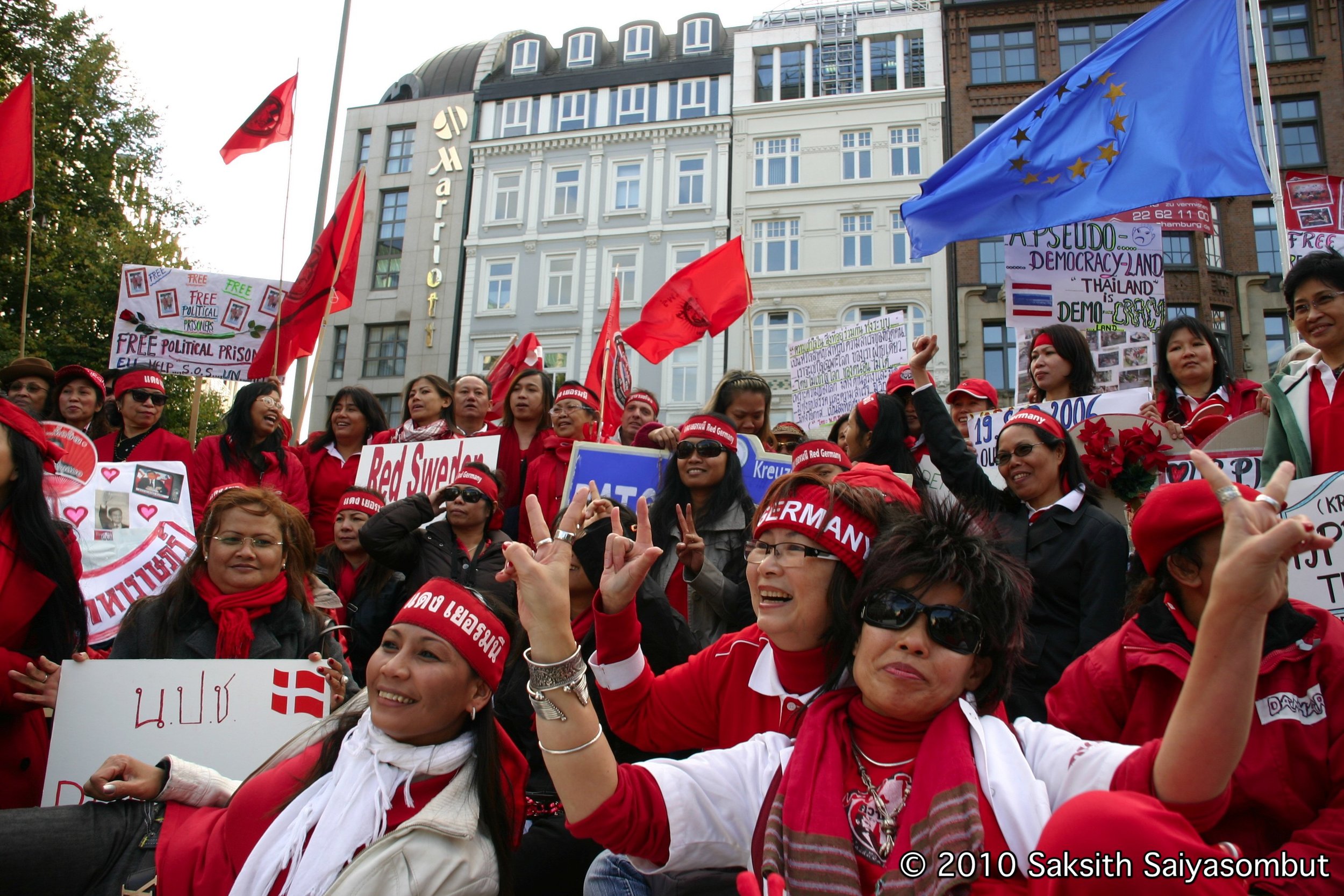
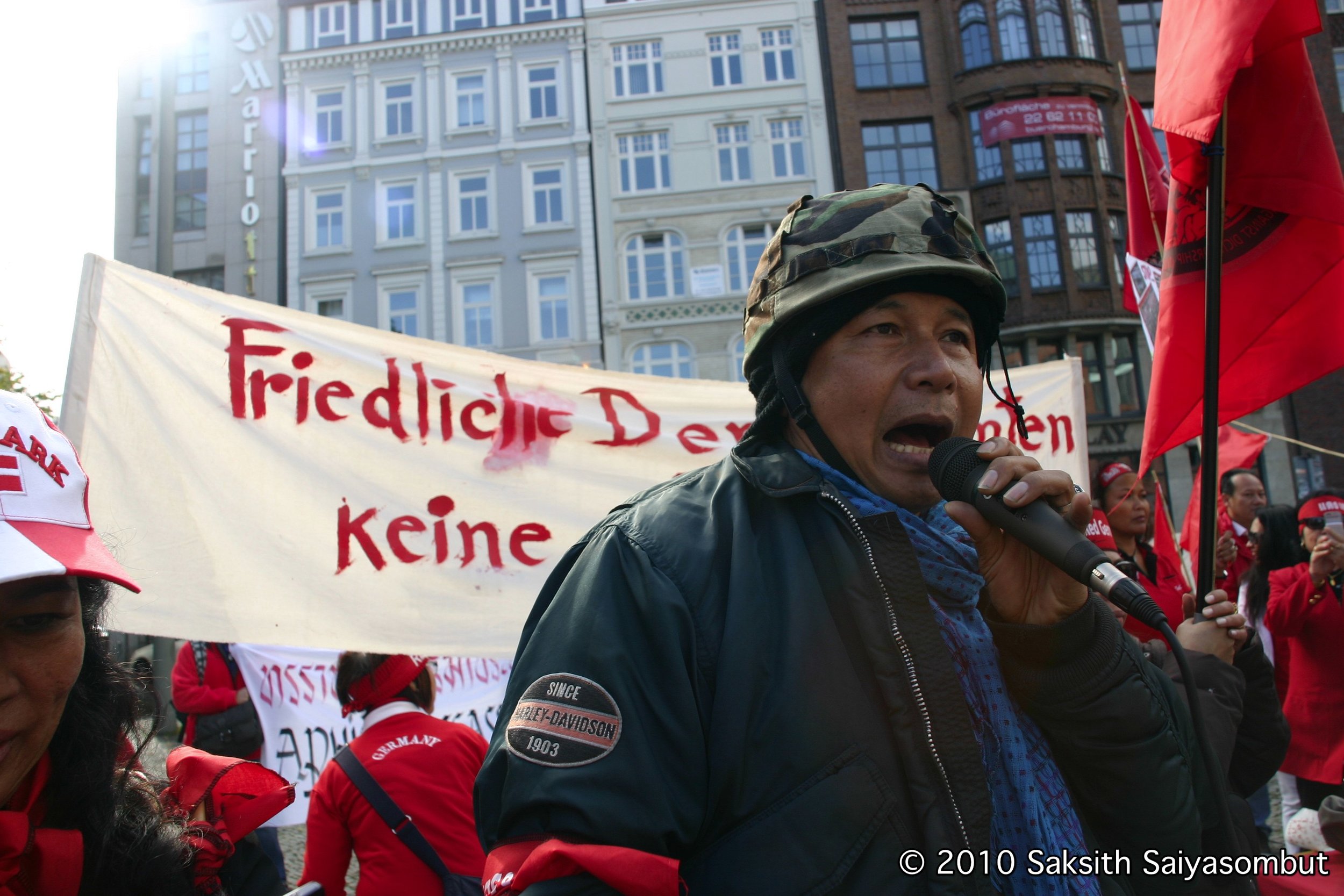
Around 120 Thai anti-government protesters from various European countries have gathered on Saturday in the German city of Hamburg to commemorate the forth-year anniversary of the military coup in Thailand and the four-month anniversary of the military crackdown against anti-government protesters in Bangkok.
The participants in this political protest, coming from Germany, France, Denmark and Belgium, are sympathizers of the United Front for Democracy against Dictatorship (UDD), also known as "red shirts", a political pressure group demanding the current Thai government to step down and call for new elections, justice for the 91 victims during the anti-government protests earlier this year among other various demands. Many of them are supporters of former Thai prime minister Thaksin Shinawatra, who has been toppled in said coup in 2006.
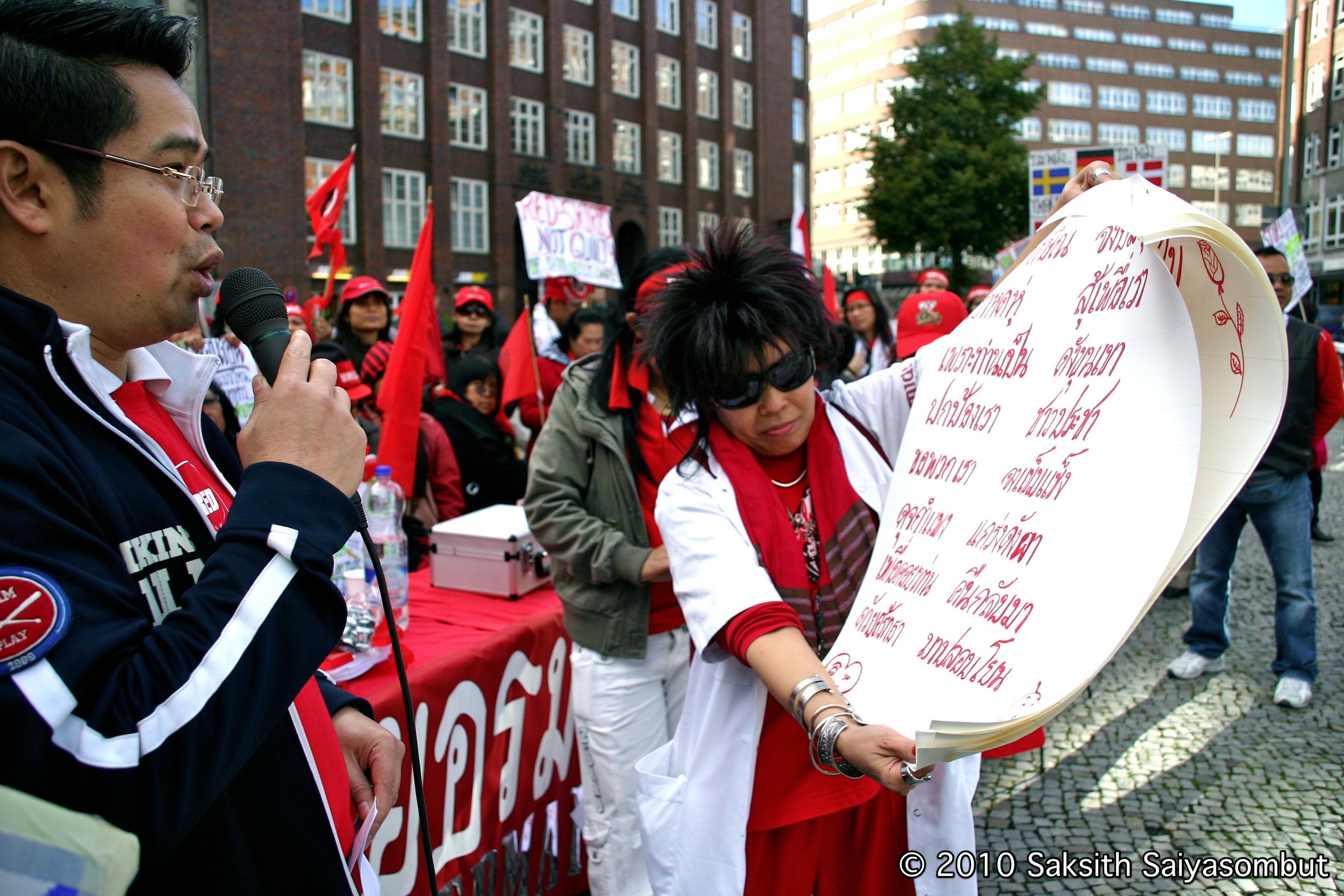
The atmosphere was largely jubilant, even though short bursts of the typical Northern German rain showers have interrupted the rally for a short period of time. Over amplifiers the protesters have made their stance over the current Thai political situation. Despite some announcements in German, most contributions over the loudspeakers were made in Thai, leaving many Hamburg onlookers asking what this event was all about.
Part of the rally was a phone-in by Thaksin, who thanked all European red shirts for the support and was overall in a conciliatory tone. He said that misunderstanding has to led conflicts and divisions among Thai people. "Today I think all sides should stop looking after themselves and look forward, no matter if they were wrong or not, and move towards each other", he said, "Bring back unity, bring back joy to the Thai people and let's make our country stronger." He continued: "The four months [since the protests' end in May] where people have killed each other, the four years [since the coup] where people made each other's lives difficult - they should come to an end." Thaksin further states that "today should be a day where we think about the mistakes made in the past and we should resolve them."
When asked by the supporters what he thinks about reconciliation he answered: "Reconciliation means to approach each other [...] and help together to move the country forward. No more yellow, no more red! But all things that were done wrong should face justice. [...] Also, there should be elections so that the people can vote their own government." Thaksin also claimed that the current political situation in Thailand "can't sustain itself for much longer." Thaksin's phone-in was cut short after nearly 11 minutes when the power generator ran out of fuel.
[audio http://dl.dropbox.com/u/531991/Thaksin-PhoneIn.mp3]
Listen to the full recording of Thaksin's phone-in here (MP3)